
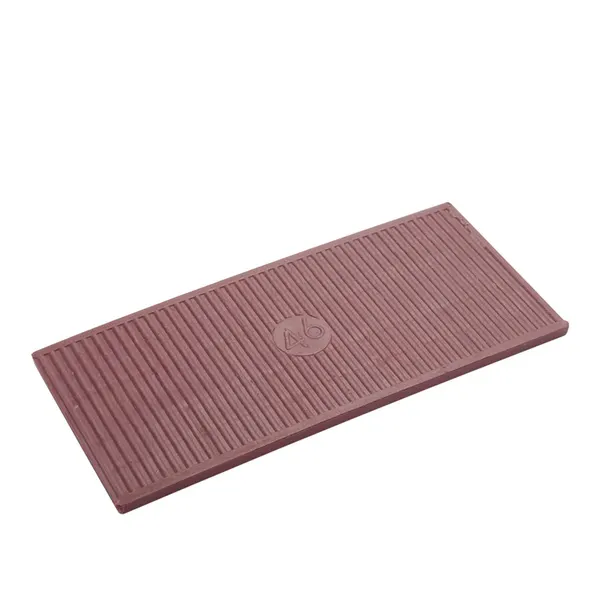
Glazing blocks are the most inconspicuous parts of a window and at the same time one of the most important. They ensure that a diamond rests on the blocks and nowhere else. If the glass is placed directly on the frame, it will experience point loads, it will stick when it expands and it can tear - a crack that you will only see months later.
The problem: blocks are sold by color and millimeters, and without a table no one knows what is what. That table is below.
The color code: which color is which thickness?
Adjustment blocks are colored per thickness. This is an industry standard, so that during inspection you can see at a glance what is there.
| Color | Thickness |
|---|---|
| Blue | 2 mm |
| Red | 3 mm |
| Yellow | 4 mm |
| Green | 5 mm |
| Black | 6 mm |
The common sizes are 100 x 40 mm and 100 x 46 mm. The 100 mm is the length of the block, the 40 or 46 mm is the width — you choose this so that the block supports the entire thickness of the glass and does not protrude halfway under the window.
Which thickness do you choose?
The thickness determines how much space remains between the glass and the rebate. Rule of thumb: keep at least 3 to 5 mm free all around. That space is necessary because the glass and frame expand with heat, and because moisture must be able to escape.
Calculate like this:
- Measure the rebate depth.
- Subtract the thickness of your glass package.
- Divide what remains over the blocks below and the sealant edge above.
When in doubt: it is better to have a block that is too thick than too thin. Too little space is the most common cause of glass breakage shortly after installation.
Three types of blocks, three functions
Adjusting blocks (or supporting blocks) carry the weight. These are located under the window and are the blocks to which the color code applies.
Tunnel blocks fill the space on the side and keep the window centered in the rebate. They are 1 mm thick and available in widths from 9 to 34 mm — you choose the width that suits your glass thickness. They are called tunnel blocks because there is an opening through which moisture and air can continue to move through the rebate. That is not a detail: a rebate that does not ventilate retains water and that will cost you the frame in the long term.
Wedges are wedge-shaped and are used to pry a window into place during installation, before the glazing bead goes on.
In addition, there are alignment blocks for horizontal positioning, drip bead blocks that specifically fit under a drip bead, and fire-resistant blocks for fire-resistant glazing — the latter are not interchangeable with regular plastic blocks.
Where do you put them?
This is where things go wrong in practice. The blocks belong not in the corners, but about a tenth of the way from each corner. The glass is most vulnerable in a corner; you don't want a point load there.
- Two supporting blocks at the bottom, each approximately one-tenth of the width from the corner.
- Side blocks left and right to keep the window centered.
- With a revolving window the positions shift: the glass must then absorb the force of the hinge, and the blocks are placed diagonally.
Never place blocks over the entire length of the bottom. The glass must be supported at two points, with space for water in between.
How much do you need?
For a normal diamond you count on four to six blocks: two supporting, two to four positioning. Blocks are sold per 100 or 1000 pieces, so one bag is enough for an entire renovation.
If you are going to install multiple windows with different glass thicknesses, a block box with an assortment (1 to 5 mm) is more convenient than individual bags — then you always have the right thickness at hand.
Does this belong to my glass order?
If you order custom glass, the blocks are not included as standard. They belong to the frame, not to the window, and the thickness you need depends on your rebate. So order them separately: view the glazing blocks.
And don't forget the bead that finishes it all off — the size you need for this is stated in glazing bead sizes and types.
In short
- Color = thickness: blue 2, red 3, yellow 4, green 5, black 6 mm.
- Keep 3 to 5 mm free between the glass and the rebate.
- Support blocks at the bottom, one-tenth of the way from the corner — never in the corner itself.
- Tunnel blocks center the window and allow the rebate to ventilate.
- Count on four to six blocks per diamond.
Are you unsure which thickness suits your rebate? Contact with the rebate size and your glass thickness and we will calculate it for you.