
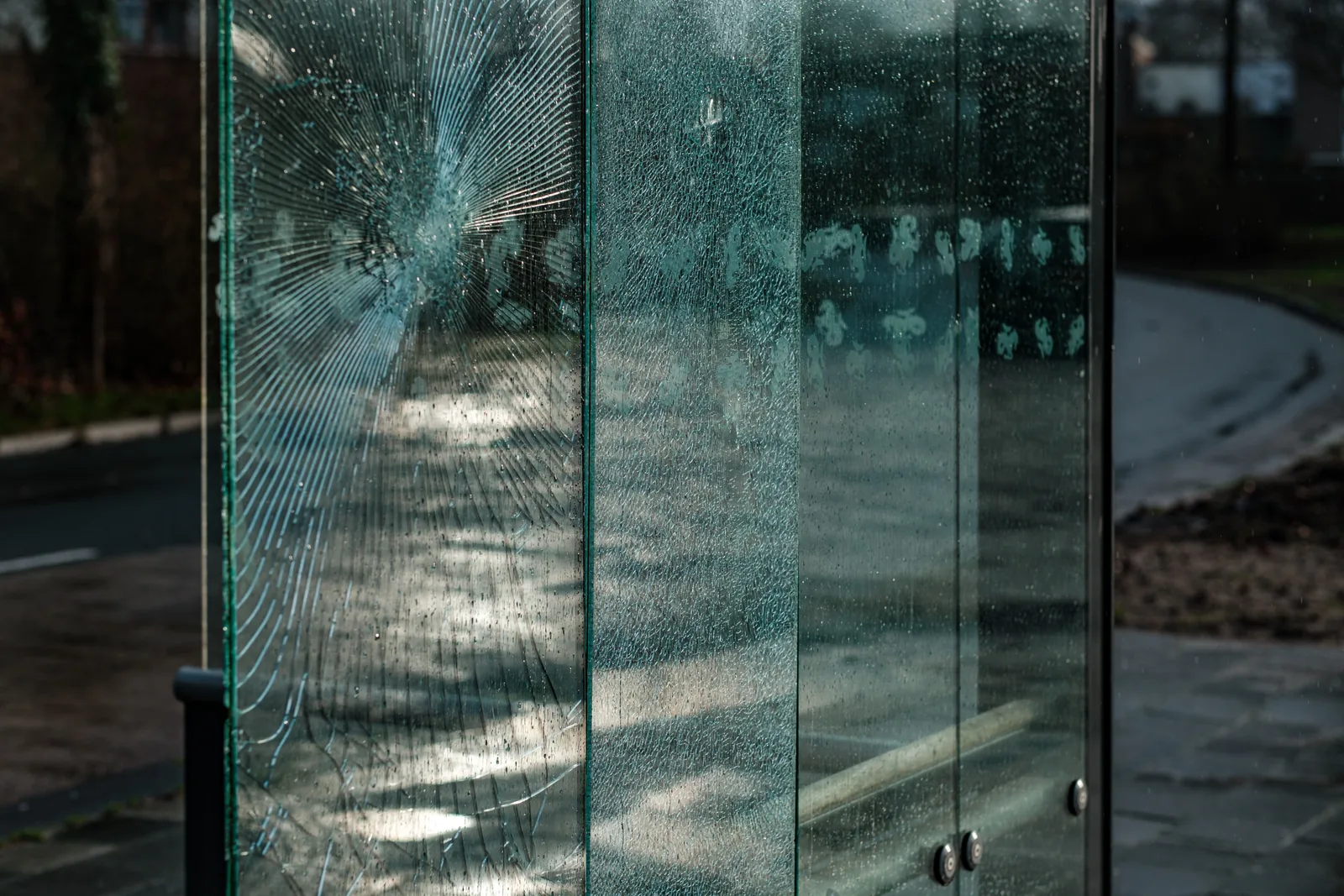
Safety glass is used in places where ordinary glass can be dangerous: low windows, glass doors, sidelights next to doors, shower walls, balustrades and glass that someone can fall into or through. The most important rule of thumb is simple: does the glass start low to the floor, is it in a door or is there a risk of falling through? Then choose safety glass.
Yet safety glass is not one product. There are mainly two commonly used types: tempered glass (ESG) and laminated glass (VSG). They look alike, but work completely differently. In this article we explain what the difference is, when to choose which type and which glass suits doors, windows, sidelights, balustrades and shower walls.
Rule of thumb: low to the floor, in or next to a door, or risk of falling through? Then safety glass.
What is safety glass?
Safety glass is glass that poses less danger if broken than standard glass. Ordinary float glass breaks into large, sharp shards that can cause deep cuts. Safety glass is designed to limit that risk. There are two main types:
- Tempered glass (ESG) — breaks into small, blunt grains.
- Laminated glass (VSG) — shards stick to a film.
Both prevent injury, but in a very different way.
Why is normal glass not always safe?
Standard glass is fine for many applications, but not for every situation. The problem mainly arises when someone can fall against the glass or when the glass starts low to the floor. When broken, sharp shards are created. This is especially dangerous with large windows, doors and low windows. Risky places are, for example:
- French doors to the garden
- front doors with glass
- side windows next to doors
- windows to the floor
- shower walls
- glass doors
- balustrades and stairwells
- roof glazing
- glass in children's areas
In such places, safety is more important than just price or appearance.
When do you need safety glass?
Safety glass is sensible or necessary in places where the risk of injury is high. Choose safety glass for:
- glass that starts low to the floor
- glass in doors and immediately next to doors
- glass in walking routes
- glass in bathrooms
- balustrades and glass stairs
- roof glazing and glass walls
- situations with a risk of falling through
A common practical limit is glass that starts lower than approximately 85 cm from the floor. If the glass is lower than that, it is wise to use safety glass. Are you in doubt? Then choose safety glass. The additional cost is often much smaller than the consequences of an unsafe situation.
What is tempered glass (ESG)?
Toughened glass is heated strongly during production and then cooled down quickly. This process makes it much stronger than standard glass. If tempered glass does break, it shatters into small grains that are much less sharp than the large shards of normal glass. Tempered glass is often used for:
- shower walls
- glass doors and interior doors
- kitchen back walls
- table tops and glass furniture
- glass that is frequently touched or must be resistant to impacts
Advantages of tempered glass
- Stronger and more impact resistant than normal glass
- breaks into small, blunt grains
- suitable for damp areas
- can withstand temperature differences well
- sleek, clear appearance
That is why tempered glass is often the logical choice for interior glass and bathroom solutions, such as a shower enclosure.
Disadvantages of tempered glass
The most important disadvantage: After hardening you can no longer process the glass. You can no longer use hardened glass afterwards:
- cutting or shortening
- drilling
- grinding
- provide recesses
All holes, hinge recesses, rounded corners and edge finishes must therefore be specified in advance. A second important point: tempered glass does not remain in one piece when broken, but falls apart into grains. That is safer than sharp shards, but if there is a risk of falling, that is not enough. For balustrades or roof glazing, you therefore usually do not choose tempered glass alone, but laminated glass.
What is laminated glass (VSG)?
Laminated glass consists of two or more glass plates with a strong plastic foil in between. This foil holds the glass plates together if the glass breaks: the shards remain stuck to it, preventing a large hole from immediately forming. Laminated glass is often used for:
- balustrades
- windows to the floor
- roof glazing and glass above people
- side lights next to doors
- fall protection
- burglar-resistant glass and safety glass in window frames
Advantages of laminated glass
- shards stick to the foil
- less chance of serious injury
- suitable for risk of falling through
- extra burglar-retardant
- applicable in insulating glass
- suitable for low windows and balustrades
For floor-to-ceiling windows, laminated glass is often the safest choice.
Disadvantages of laminated glass
Laminated glass is usually more expensive than standard glass and also heavier, because it consists of multiple layers. Moreover, not all laminated glass is automatically suitable for every construction — a balustrade requires a different construction than a low window in a living room. Therefore please note:
- glass thickness and number of glass layers
- type of foil
- confirmation and height difference
- tax
- application indoors or outdoors
For fall protection, the entire construction must be correct, not just the type of glass.
Tempered glass or laminated glass: what's the difference?
The difference is mainly in the fracture behavior.
| Attribute | Tempered glass (ESG) | Laminated glass (VSG) |
|---|---|---|
| Breaking behavior | Breaks down into small grains | Shards stick to foil |
| Stronger than normal glass | Yes | Depending on structure |
| Remains close to break | No | Yes |
| Suitable for shower walls | Yes | Uncommon, but less common |
| Suitable for balustrades | Not as a single plate | Yes, with correct structure |
| Suitable for risk of falling through | Usually not just | Yes |
| Post-edit | No | Usually not wise |
| Typical application | Shower, door, table | Balustrade, low window, roof glass |
In short: tempered glass breaks safely into small grains, laminated glass remains attached to the foil when broken. Choose tempered when glass must be strong and break safely; choose laminated if the glass must remain in place if it breaks.
When do you choose tempered glass?
Choose tempered glass for applications where the glass is often touched, bumped or used:
- shower walls
- glass (interior) doors
- kitchen back walls
- table tops and wall panels
- glass furniture and display cases
- glass with visible edges
Tempered glass is especially popular in the bathroom. Please note: for a glass door or shower wall you must determine the exact holes and recesses in advance. Retrospective adjustment is not possible.
When do you choose laminated glass?
Choose laminated glass if the glass should not fall open if broken:
- balustrades
- roof glazing
- windows to the floor
- side lights next to doors
- glass along stairs
- fall protection
- insulating glass at risk areas and windows at height differences
For a window that starts lower than 85 cm from the floor, laminated safety glass is often wise. Laminated glass is almost always necessary for a balustrade, because no hole should be created if it breaks.
Safety glass per application
Safety glass on windows
Not every window has to be safety glass. A standard window that starts high enough and is not easy to fall into can often be made with standard insulating glass. Safety glass is important for:
- windows to the floor
- low windows in living rooms
- windows next to doors
- windows in children's rooms
- windows along stairs
- glass for height differences
With insulating glass you can combine safety with insulation. For example, one side of a HR++ pane is made as laminated glass: better insulation and more safety.
Safety glass on doors
Glass in doors is vulnerable. A door moves, can blow shut and is often used. People also sometimes bump into the glass. Therefore, always choose safety glass for glass doors or doors with glass. Depending on the situation, this can be tempered glass, laminated glass, tempered-laminated glass or laminated insulating glass. Tempered glass is often used for interior doors; Laminated glass is often more sensible for exterior and front doors, especially because of burglary resistance and injury safety.
Safety glass at side lights
A sidelight is the narrow window next to a door. This glass is often located in a walking route and usually starts low to the floor, which increases the chance that someone will fall or bump into it. Laminated safety glass is often a good choice for sidelights — especially for front doors, entrances and heavily used passageways.
Safety glass on balustrades
Safety is extra important with balustrades. This is not only about the risk of cutting, but also about the risk of falling: a balustrade must prevent someone from falling down. Therefore, the glass must remain in place if it breaks. You usually use laminated safety glass with a suitable structure. The correct thickness depends on:
- height difference
- mounting system (glass clamps or profiles)
- indoor or outdoor application
- load and dimensions
- regulations and construction requirements
Never use just standard glass or only tempered glass for a balustrade.
Safety glass on shower walls
Tempered glass is usually used for shower walls, because shower glass must be able to withstand temperature differences, impacts, daily use, moisture, cleaning and attachment with fittings. Commonly used thicknesses are 8 or 10 mm. The edges are usually flat poly ground, so that they have a safe and smooth finish.
Is HR++ glass automatic safety glass?
No — this is a common misconception. HR++ glass is insulating glass: that says something about the insulation value, not automatically about safety. Standard HR++ glass can consist of normal float glass. If you apply this in a risk area, it is not automatically safe from injury.
Do you want HR++ glass in a place where safety is important? Then choose a HR++ pane with a layered or hardened composition, for example:
- HR++ laminated glass for low windows
- HR++ safety glass next to doors
- laminated insulating glass in case of risk of falling through
Choose safety glass per situation
| Situation | Recommended glass |
|---|---|
| Standard window above 85 cm | Ordinary insulating glass can often be used |
| Window to the floor | Laminated safety glass |
| Front door with glass | Laminated glass or safety glass |
| Glass interior door | Tempered glass |
| Side light next to door | Laminated safety glass |
| Shower enclosure | Tempered glass |
| Balustrade | Laminated safety glass |
| Roof glazing | Laminated glass |
| Kitchen back wall | Tempered glass |
| Table top | Tempered glass |
This table is a practical guideline. In case of doubt or complex situations, advice is important.
Common mistakes with safety glass
- Thinking that thick glass is always safe — a thick standard pane of glass can still break into sharp shards. Thick glass is not automatically safety glass.
- HR++ confuse glass with safety glass — HR++ says something about insulation, not automatically about injury safety.
- Only use tempered glass if there is a risk of falling through — tempered glass breaks safely, but does not remain sealed. If there is a risk of falling through, you usually need laminated glass.
- Forgot holes for tempered glass — tempered glass cannot be drilled afterwards. All holes must be specified in advance.
- Choose the wrong glass thickness — for balustrades, doors and large glass panes, the correct glass thickness is essential.
- Only look at price — safety glass is more expensive than standard glass, but in high-risk areas it is the right investment.
Checklist: do I need safety glass?
Answer these questions:
- Does the glass start lower than approximately 85 cm from the floor?
- Is the glass in a door?
- Is the glass next to a door?
- Can someone fall against the glass?
- Is there a height difference behind the glass?
- Is the glass used as a balustrade?
- Is the glass in a bathroom?
- Is the glass touched often?
- Is the glass part of a walking route?
- Is there a chance of falling through?
Do you answer "yes" to one or more questions? Then safety glass is probably wise or necessary.
Conclusion
You choose safety glass not only because it is stronger, but mainly because it is less dangerous if it breaks. For shower walls, glass doors, table tops and kitchen back walls, tempered glass (ESG) is often the best choice. For low windows, sidelights, balustrades and roof glazing, laminated glass (VSG) is usually more sensible, because it remains in place if broken.
Remember the difference: tempered glass breaks safely into small grains, laminated glass sticks to the film when broken. Are you ordering glass for a risk location? Then do not automatically choose standard HR++ glass or ordinary float glass — first check whether safety glass is necessary and which version fits.
Read more: edge finish of glass, what glass thickness do you choose and frosted glass or laminated glass.
Ready to order? Check out our safety glass or customize your glass — our configurator automatically does a free safety check while you put together.