
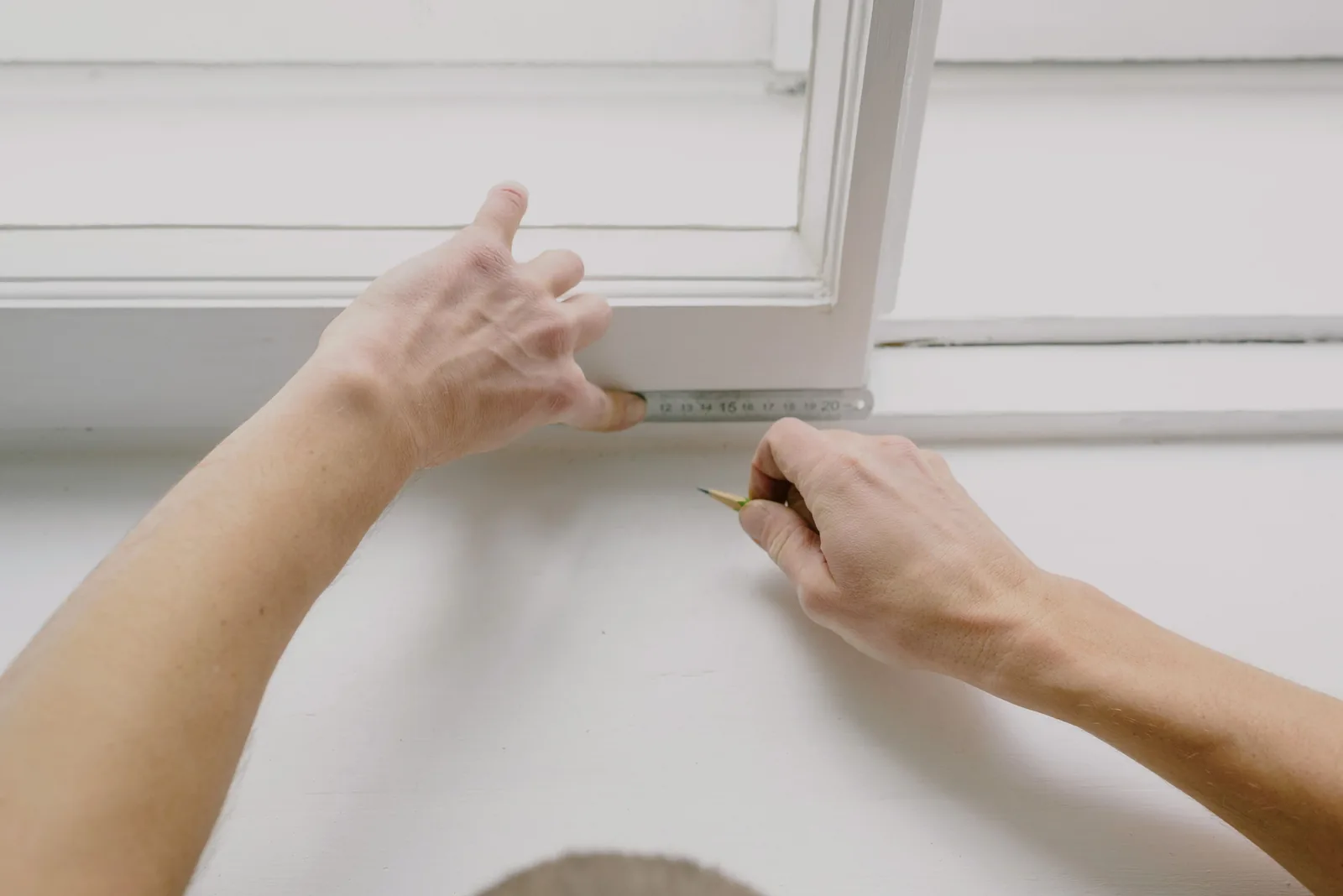
Ordering custom glass starts with measuring properly. A window that is a few millimeters too large will not fit. A window that is too small can rattle, seal poorly or look untidy. Because glass usually cannot be adjusted after production, accurate measuring is important.
The most important rule is simple: always measure glass in millimeters, measure in multiple places and use the smallest size as a starting point. For glass in a frame, measure the tight rebate size and usually subtract 8 mm from width and height. For shower walls, glass doors and walls without a frame, measure the tight day size. In this article we explain step by step how to do this — including measurement examples, the deduction for a ventilation grille and a handy checklist.
Rule of thumb: measure in millimeters, measure in multiple places and always take the smallest size.
Why is measuring glass properly so important?
Glass is custom work. Once a window has been produced, you cannot simply make it smaller. This certainly applies to:
- HR++ glass
- triple glass
- vacuum glass
- tempered glass
- laminated glass
- shower glass
- glass with holes or recesses
A measurement error may therefore mean that you have to order again. With glass it's all about millimeters. A window frame may seem straight, but in practice many window frames are slightly crooked. Wood works through temperature and moisture. Old window frames can sag. Walls are not always straight. That is why you never measure in one place, but always at several points.
What do you need to measure glass?
You don't need much for proper measuring, but you should definitely use measuring tools. Handy to prepare:
- sturdy tape measure
- pencil
- paper or measurement form
- spirit level
- possibly square
- phone for photos
- flashlight for deep rebates
- gloves for old or broken windows
Always measure in millimeters. So not "about 80 cm", but for example 798 mm. If in doubt, make a simple sketch of the frame or opening. Add the width, height and any special features, such as a ventilation grille, sloping wall or existing profile.
What is the rebate size?
The rebate is the recess in the frame into which the glass falls. With a wooden, plastic or aluminum frame, the pane is not simply against the window, but in a recess. The tight rebate size is the size of the opening into which the glass could maximum fall, measured from frame edge to frame edge.
So you do not measure the old window, but the opening in the frame. That is important, because the old window can:
- have been too small
- are incorrectly placed
- are damaged
- otherwise sealed
- no longer displaying the correct size
Therefore, always measure the frame itself.
How do you measure glass in a frame?
For glass in a frame, measure the width and height of the tight rebate size.
Measure width
Measure in three places (top, middle, bottom), write all three down and use the smallest one.
| Measuring point | Width |
|---|---|
| Above | 1002 mm |
| Middle | 1000 mm |
| Below | 998 mm |
Use 998 mm.
Measure height
Measure in three places (left, center, right) and use the smallest one.
| Measuring point | Height |
|---|---|
| Left | 1201 mm |
| Middle | 1199 mm |
| Right | 1200 mm |
Use 1199 mm.
How do you calculate the final glass size?
Glass should not clamp tightly in the frame. There must be room for glazing tape, sealant, glazing beads and operation of the material. With standard glass in a frame you often subtract 8 mm from the width and 8 mm from the height. This leaves you with approximately 4 mm clearance all around.
| Step | Width | Height |
|---|---|---|
| Smallest rebate size | 998 mm | 1199 mm |
| Deduction | −8 mm | −8 mm |
| Order size glass | 990 mm | 1191 mm |
The order size is therefore 990 × 1191 mm.
Please note: this is a practical rule of thumb for many standard situations. Other regulations may apply to specific systems or special types of glass.
Why do you have to cut corners?
Clearance is necessary because glass and frames do not stand completely still. Materials can work slightly due to temperature, moisture and wind load. Without play, glass can:
- get stuck
- build up tension
- break
- poor sealing
- getting pressure from screws or glazing beads
- cause problems during installation
Those few millimeters of space are therefore not a mistake, but necessary for proper placement.
Measure glass with ventilation grille
Will there be a ventilation grille above the glass? Then the window becomes lower. The grille takes up part of the height. The order:
- Measure the tight rebate size.
- Subtract the normal 8 mm.
- Then subtract the glass deduction of the grid from the height.
| Step | Width | Height |
|---|---|---|
| Smallest rebate size | 1000 mm | 1200 mm |
| Normal deduction | −8 mm | −8 mm |
| Intermediate size | 992 mm | 1192 mm |
| Glass deduction grid | 0 mm | −80 mm |
| Order size glass | 992 mm | 1112 mm |
Order glass of 992 × 1112 mm. Always check the exact glass reduction of the ventilation grille; not every grid has the same deduction size.
What is the day size?
The day size is the free opening between two fixed points. Consider the distance between two walls, between floor and ceiling or between two posts. You mainly use the daylight size for glass without a traditional frame, such as:
- shower walls
- glass doors
- partition walls
- glass walls
- niche solutions
- interior glass
With a daylight size you do not measure in a rebate, but the open space in which the glass should be placed.
How do you measure a shower enclosure?
With a shower wall, measure the free space where the glass should be placed. Always measure in multiple places:
- width bottom, middle, top
- height left, right
- any floor or wall difference
Bathroom walls and tile walls are rarely perfectly straight. With shower glass you should not simply deduct slack yourself. The correct glass size depends on the profile, the glass thickness, the fittings, the hinges, the placement, any stabilizing bar and the mounting method. Therefore, use the configurator for shower walls or ask for advice. Enter the requested daylight size carefully so that the correct glass size can be calculated.
How do you measure a glass door?
Accurate measuring is extra important with a glass door. In addition to width and height, you also have to take into account hinges, closures, direction of rotation and any holes. NB:
- tight daylight size of the opening
- desired space around the door
- position of hinges
- direction of rotation
- floor finishing
- sill or no sill
- handle or lock case
- any recesses
Tempered glass cannot be drilled or adjusted after production. All holes and recesses must therefore be correct in advance — you can read more about this in tempered or laminated glass. Always make a clear drawing with dimensions in millimeters for glass doors.
Do you need to measure the old window?
Usually not. Measuring the old window seems useful, but can be misleading. The old window may be too small, too large or incorrectly placed. Additional sealant or putty may also have been used to hide an incorrect size. Therefore it is better to measure:
- the rebate of the frame
- the daylight size of the opening
- the mounting points
- the existing profiles
Only if you replace exactly the same glass in exactly the same system and are sure that the old window fit properly, the old window can serve as a check. It is also wise to measure the frame afterwards.
Do you measure including or excluding glazing beads?
With glass in a frame, you measure the rebate, not the visible size between the glazing beads. Glazing beads are usually removed before the window is installed. The window falls into the rebate behind the glazing beads. If you only measure the visible opening between glazing beads, there is a good chance that you will get a size that is too small. When in doubt you can:
- carefully remove a glazing bead
- make the rebate visible
- measure where the glass actually falls
- take pictures of the situation
Measuring old wooden frames
Old wooden frames require extra attention. They are often not completely straight and may have started to work over the years. NB:
- wood rot
- crooked rebate
- old putty
- loose glazing beads
- layers of paint
- shallow rebate
- limited space for HR++ glass
- sagging rotating parts
Do you want to replace single glass with HR++ glass? Then check not only the width and height, but also the rebate depth. HR++ glass is much thicker than single glass. You can read more about this in thicker insulating glass in an existing frame.
Measuring for insulating glass
With insulating glass you have to pay extra attention to thickness and structure. The size must be correct, but the glass must also fit in the frame. Check:
- width
- height
- total glass thickness
- rebate depth
- space for glazing tape
- space for glazing beads
- any ventilation grilles
- weight of the window
- condition of hinges on rotating windows
A HR++ pane of 24 mm does not automatically fit in every old window frame. Sometimes cover slats or nose slats are necessary. For very narrow window frames, vacuum glass may be a better choice. Don't know yet what thickness you need? Then read which glass thickness you should choose. You assemble the insulating glass itself in the insulating glass configurator, where you enter the structure and glass size.
Common mistakes when measuring glass
- Measure in one place — Frames are often crooked; measure in multiple places.
- Measure the old window — The old window may be wrong; prefer to measure the rebate or daylight size.
- Do not apply deduction — Glass needs clearance; Without deduction the window can get stuck.
- Applying too much deduction — Too much play will cause a window to rattle or seal poorly.
- Forgot the ventilation grille — You have to make an extra glass deduction for a grille.
- Measure in centimeters — Always measure and order in millimeters.
- Reverse width and height — Always write width × height.
- Do not take glass thickness into account — Thickness is especially important with HR++, triple and vacuum glass.
- Forgot holes or cutouts — Tempered glass requires holes to be made in advance.
- Do not check before ordering — Please check all sizes at least twice.
Do not reverse width and height
It often goes wrong: width and height are reversed. Always write measurements as width × height. For example, 800 × 1200 mm means 800 mm wide and 1200 mm high. Also put this clearly on your sketch. This prevents confusion, especially with multiple windows.
Rounding of glass sizes
Do not round glass sizes to centimeters. Always order in millimeters.
| Not so | But so |
|---|---|
| 80cm | 800 mm |
| about 1 meter | 1000 mm |
| 79.5cm | 795 mm |
With glass, even a 5 mm difference can be important.
Quick decision aid: what should you measure?
| Project | What do you measure? | What do you deduct? |
|---|---|---|
| Glass in frame | Tight rebate size | Often 8 mm width and height |
| HR++ glass | Rebate size + rebate depth | Deduction + check thickness |
| Glass with grid | Rebate size | 8 mm + glass deduction grid |
| Shower enclosure | Tight daylight | Do not correct yourself without system information |
| Glass door | Tight daylight size + fitting positions | Depending on batter |
| Display cabinet | Inner cabinet size | Depending on profile and overlap |
| Balustrade | Total opening + confirmation | Depending on system |
Separate rules apply to a display cabinet and a balustrade - see the corresponding pages.
Measuring glass checklist
- Do I measure in millimeters?
- Did I measure the width and height in three places?
- Do I use the smallest size?
- Do I measure the rebate instead of the old window?
- Have I applied the correct deduction?
- Is there a ventilation grille? Do I know the glass deduction of the grille?
- Have I checked the glass thickness? Does the glass fit in the rebate?
- Were glazing beads, tape and sealant included?
- Have I recorded width × height correctly?
- Are holes or recesses needed?
- Did I double check the sizes?
- Did I take photos if in doubt?
Conclusion
Measuring glass properly prevents expensive mistakes. Always measure in millimeters, measure in multiple places and use the smallest size as a starting point. For glass in a frame, measure the tight rebate size and usually subtract 8 mm from width and height. With a ventilation grille, you then also deduct the glass deduction from the grille. For shower walls, glass doors and other applications without a frame, measure the clear daylight size. Do not simply deduct clearance yourself, because the correct glass size depends on profiles, fittings and mounting method.
Read more: which glass thickness do you choose, edge finishing: sharp or ground edges and tempered or laminated glass.
Are you unsure about your size? Please take photos of the frame or opening and check your measurement before ordering. Ready to order? Create your glass in the custom glass configurator.