
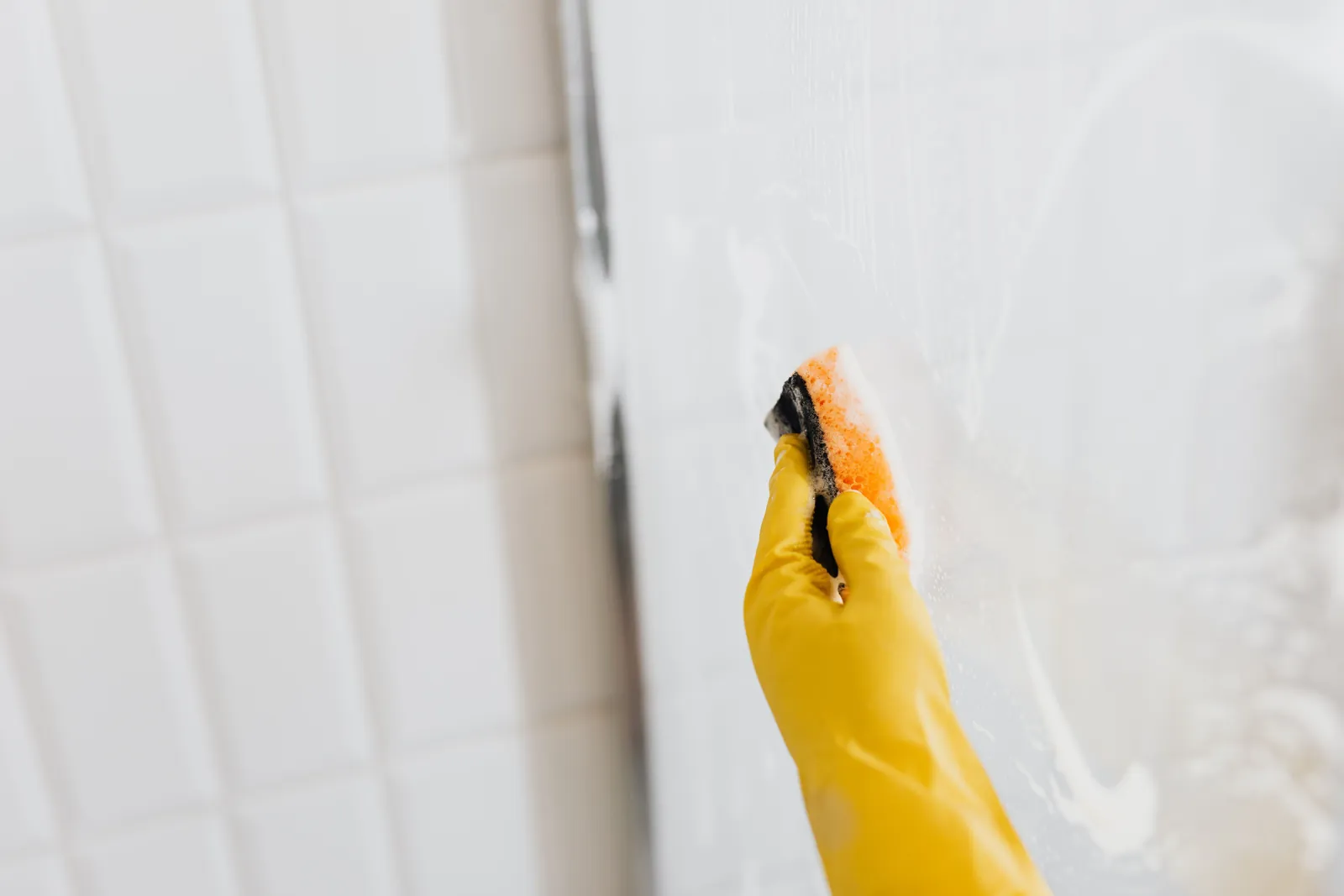
Limescale on shower glass is a common problem. Your shower wall looks dull, white spots remain and even after cleaning, the glass no longer appears completely clear. This is usually caused by limescale from the water, combined with soap residue and dirt. The short rule is: You can remove limescale on shower glass with a mildly acidic cleaning agent, such as diluted cleaning vinegar or a suitable bathroom cleaner. Always rinse thoroughly and dry the glass to prevent new deposits.
In this article we explain how limescale is formed, how to remove it safely, what you should pay attention to with an anti-limescale coating and how you can prevent your shower glass from becoming dull again.
What is limescale?
Limescale is caused by minerals in water. Especially in areas with hard water, there are relatively many lime particles in the tap water. When water dries on glass, those minerals are left behind as white spots or haze.
You often see limescale on shower glass as:
- white drop spots
- dull haze
- stripes
- rough touch
- matte spots
- stains that do not disappear with regular glass cleaner
Limescale builds up slowly. The longer you wait before cleaning, the more difficult it becomes to get the glass clear again.
Why does limescale form on shower glass?
Shower glass is exposed to a lot of water every day. After showering, drops remain on the glass. When those drops dry, lime remains behind. In addition, limescale residues often mix with shampoo, soap, shower gel, skin oil, dirt, cleaning residues, dust and hard water residues. This creates a persistent layer that does not always disappear with regular glass cleaner.
Is limescale bad for glass?
Limescale is primarily a cleaning problem in the beginning: the glass looks dull and dirty. But if limescale remains for a long time, it can become increasingly difficult to remove. Long-term limescale can cause:
- permanent dull spots
- rough touch
- spots that appear deeply withdrawn
- damage to coatings
- more dirt adhesion
- a less bright appearance
You have to be especially careful with coated shower glass. Cleaning too aggressively can damage the protective layer.
How do you remove light limescale?
You can usually remove light limescale easily with a mildly acidic product. Lime dissolves better with acid than with regular soap.
A simple method:
- Wet the glass with warm water.
- Apply diluted cleaning vinegar or a mild bathroom cleaner.
- Let it work briefly.
- Rub gently with a soft sponge or cloth.
- Rinse thoroughly with clean water.
- Dry the glass with a microfiber cloth or squeegee.
Do not use a scouring pad. This can cause fine scratches.
Core rule of thumb: mild acidic agent, rinse thoroughly and dry the glass. And most importantly, you can prevent this by wiping the shower glass dry after each use.
Use cleaning vinegar on shower glass
Cleaning vinegar is often used against limescale. That can work well, but use it wisely. Preferably make a mixture of:
- 1 part cleaning vinegar
- 1 part water
Apply this to the glass and let it work for a few minutes. Then rinse thoroughly. Note: Do not let vinegar sit for too long on sealant edges, natural stone, metal profiles or coatings. Vinegar is acidic and can corrode some materials. So use vinegar mainly on the glass itself, not as an all-purpose cleaner for the entire bathroom.
Can you use natural vinegar?
Natural vinegar is milder than cleaning vinegar. It can help with light limescale deposits, but is less effective. Natural vinegar is suitable for:
- light limescale stains
- regular maintenance
- small shower walls
- situations where you want to clean more gently
Cleaning vinegar or a special bathroom cleaner often works better for heavy limescale deposits.
Bathroom cleaner against limescale
There are many bathroom cleaners that are specifically designed to combat limescale. These can work well, as long as they are suitable for glass and shower walls. When purchasing, pay attention to whether the product:
- suitable for glass
- suitable for the shower wall
- is not abrasive
- is safe for profiles
- safe for coating (if present)
- has clear instructions for use
Always follow the instructions on the packaging. Allowing more product to work for longer is not always better.
Remove stubborn limescale
For stubborn limescale, cleaning once is often not enough. Then you have to treat the attack in several rounds:
- Wet the glass.
- Apply limescale cleaner or diluted cleaning vinegar.
- Allow to act briefly.
- Rub with a soft sponge.
- Rinse thoroughly.
- Repeat if necessary.
- Dry the glass completely.
It is better to work in several gentle rounds than one very aggressive session. This way you prevent damage to glass, sealant or coating.
What should you not use on shower glass?
Do not use agents or materials that can cause scratches or damage coatings. Avoid:
- scouring sponge
- steel wool
- abrasive
- aggressive descaler
- chlorine in combination with other agents
- sharp metal scrapers
- coarse salt
- hard brushes
- scouring cream
- oven cleaner
These agents can dull the glass, cause scratches or damage the protective layer. See also repair scratch in glass if it is already too late.
Be careful with anti-limescale coating
Many modern shower walls have an anti-limescale coating. This coating ensures that water adheres less easily to the glass, keeping it clean for longer. But such a coating can be damaged by incorrect cleaning agents. Use with coated shower glass:
- a soft cloth
- a mild cleanser
- no abrasives
- no aggressive acids
- no hard brushes
- no scouring pad
- products suitable for coating
Are you unsure whether your shower glass has a coating? Always choose a mild approach.
How do you know if shower glass has a coating?
That is not always easy to see. Sometimes it is on the invoice or product information. You can sometimes notice this in the behavior of water: water often beads off more quickly on coated glass, while water on untreated glass remains more as flat drops or stripes. Check:
- product information
- quotation or invoice
- manual of the shower enclosure
- supplier
- the water-repellent effect
- any stickers or markings
When in doubt, do not use aggressive products.
Lime or soap residue?
Not every haze on shower glass is pure limescale. It is often a combination of lime and soap residue. Soap residue sometimes feels greasy, while lime tends to feel rough or dry.
| Problem | Recognition | Solution |
|---|---|---|
| Lime | White hard spots | Mild descaler |
| Soap scum | Oily haze | Warm water + mild detergent |
| Combination | Dull, persistent layer | First degrease, then descale |
| Scratches | Remain visible after cleaning | Cannot be brushed away |
| Coating damage | Irregular dull spots | Often not repairable |
If glass remains dull after descaling, there may be scratches, coating damage or burnt-on deposits.
Alternative remedies: do they work?
Clean shower glass with lemon
Lemon contains acid and can help against limescale. However, lemon is usually less practical than a suitable limescale cleaner or diluted vinegar. Lemon can work for small stains, light limescale and a quick freshen up. Note: Citric acid is also acidic. Do not leave it on natural stone, sealant or metal parts for a long time and always rinse thoroughly.
Baking soda against limescale?
Baking soda is often mentioned as a cleaning agent, but you have to be careful with this for shower glass. Baking soda can be slightly abrasive. If you rub too hard, you can make fine scratches. Avoid using baking soda on:
- coated shower glass
- new glass
- glass with anti-limescale coating
- frosted glass
- vulnerable profiles
- places where you have to scrub hard
For lime, a mildly acidic agent usually makes more sense than an abrasive agent.
Can you use a glass scraper?
A glass scraper can be useful for flat glass, but shower walls require caution. An incorrectly used scraper can scratch. Only use a scraper if:
- the glass is flat and uncoated
- you use a sharp, clean knife
- the glass is wet
- you keep the scraper flat
- do not pry at edges or profiles
Do not use a scraper on frosted glass, coated glass or glass with foil.
Limescale on the rest of the shower wall
Limescale on the shower door
A shower door often has limescale around the handle, bottom and hinges. Drops and soap residue get stuck there. NB:
- clean batter carefully
- do not use aggressive agents on black or stainless steel parts
- Rinse hinges thoroughly
- dry metal parts
- prevent cleaner from remaining in rubbers or profiles for a long time
Limescale can accumulate along the edges of doors with sealing strips. Remove dirt from there regularly.
Limescale on a shower wall with black profiles
Black profiles are popular, but they can be sensitive to visible limescale stains and damage from aggressive agents. For black profiles, use a mild cleaner and a soft cloth, not an abrasive cleaner, scouring pad or aggressive descaler. Rinse well and dry immediately. Preferably spray the cleaner on the cloth instead of liberally over profiles and glass.
Limescale on sealant edges
Sealant edges can also retain lime and soap residue. Clean them carefully, as sealant can be damaged by aggressive agents or hard scrubbing. Tips:
- use a soft brush or cloth
- use a mild bathroom cleaner
- do not allow acid to act for too long
- rinse thoroughly
- dry the sealant edge
- check for mold
- replace damaged kit on time
Is the sealant black or moldy? Then descaling is not enough. Then you have to tackle the mold or replace the sealant. If you choose to replace, read which kit you use for what.
How do you prevent limescale?
Prevention is much easier than removing stubborn limescale. The best habits:
- wipe shower glass dry after every shower
- dry edges and profiles
- ventilate the bathroom
- clean lightly weekly
- use a mild cleaning agent
- remove soap residue in time
- avoid stagnant water
- If necessary, use an anti-limescale coating
A shower pull is the simplest and most effective solution. You can find a squeegee, glass cleaner and microfibre cloth in our glass articles and maintenance products.
Wipe shower glass dry after use
If you wipe the glass dry after each shower, water droplets have less chance of leaving limescale behind. It takes less than a minute and avoids a lot of cleaning work. Tips:
- hang a trigger in the shower
- pull from top to bottom
- also dry the bottom edge
- take the profiles with you
- dry with a cloth if necessary
This is especially important in areas with hard water. See also our explanation about cleaning glass without streaks.
Does a water softener help?
A water softener can reduce limescale because there is less lime in the water. This makes it easier for shower glass to stay clean. Advantages:
- fewer limescale stains
- less deposits on taps
- less cleaning work
- shower glass stays clear longer
Note: Even with a water softener you still have to clean. Soap residue and dirt remain.
Reapply anti-limescale coating
Some coatings wear off over time. Then water will not drain off the glass as well. With a surface protection for glass you can reapply a water-repellent layer yourself. NB:
- the glass must be very clean
- old lime must first be removed
- the product must be suitable for shower glass
- follow the instructions carefully
- the effect is temporary
- regular maintenance remains necessary
A coating helps, but does not completely replace cleaning.
When is glass no longer easy to clean?
Sometimes limescale doesn't seem to disappear anymore. This may involve long-term deterioration, scratches or coating damage. Glass may be permanently damaged when:
- the haze remains after descaling
- the surface remains rough
- dull spots remain visible
- scratches are visible
- the coating has become uneven
- aggressive substances have been used before
In that case, replacement is sometimes the only way to get completely clear glass again. Are you thinking about a new wall? Then read what you should pay attention to with a custom shower enclosure.
Common mistakes with limescale
- Waiting too long — the longer lime remains, the more difficult it becomes.
- Use scouring pad — this may cause scratches.
- Use descaler that is too aggressive — this can damage coating, sealant or profiles.
- Do not rinse — cleaner residue can cause new haze.
- Do not dry glass — water that dries again leaves limescale behind.
- Forgot the coating — an anti-limescale coating requires mild cleaning.
- Clean glass only — limescale is often also found on profiles, rubbers and sealant edges.
Selection aid: how do you tackle limescale?
| Situation | Best approach |
|---|---|
| Light limescale stains | Diluted vinegar or mild bathroom cleaner |
| Stubborn lime | Multiple short treatments |
| Shower glass with coating | Coating-friendly cleaner |
| Black profiles | Mild cleaner, rinse quickly |
| Lime + soap residue | First degrease, then descale |
| Dull haze remains | Check for scratches or coating damage |
| New shower enclosure | Dry immediately after use |
| Lots of hard water | Consider water softener or coating |
Checklist for clear shower glass
- Is the glass coated?
- Are you using a mild remedy?
- Are you not using a scouring pad?
- Do you rinse thoroughly?
- Do you dry the glass?
- Do you also clean profiles and edges?
- Do you wipe the glass dry after showering?
- Do you ventilate the bathroom?
- Do you clean lightly every week?
- Don't let limescale build up for months?
- Do you not use aggressive substances on black profiles?
- Do you check sealant edges for mold?
Conclusion
Limescale on shower glass occurs when water dries and lime particles are left behind. The longer the lime remains, the more difficult it becomes to get the glass clear again. Fortunately, you can often remove light and normal limescale with a mildly acidic product, such as diluted cleaning vinegar or a suitable bathroom cleaner. Do not use a scouring sponge, abrasive cleaner or aggressive descaler, especially on shower glass with an anti-limescale coating. Always rinse thoroughly and dry the glass.
The best solution remains: dry the shower glass after every shower, ventilate the bathroom and regularly clean the glass lightly.
Read more:
- Custom-made shower enclosure: what to look out for
- Clean glass without streaks
- Repair scratch in glass
- Tempered glass: what is it?
- Which kit do you use for what?
Looking for a new custom shower wall or glass? Create your own custom shower enclosure or view our shower and bath solutions.