
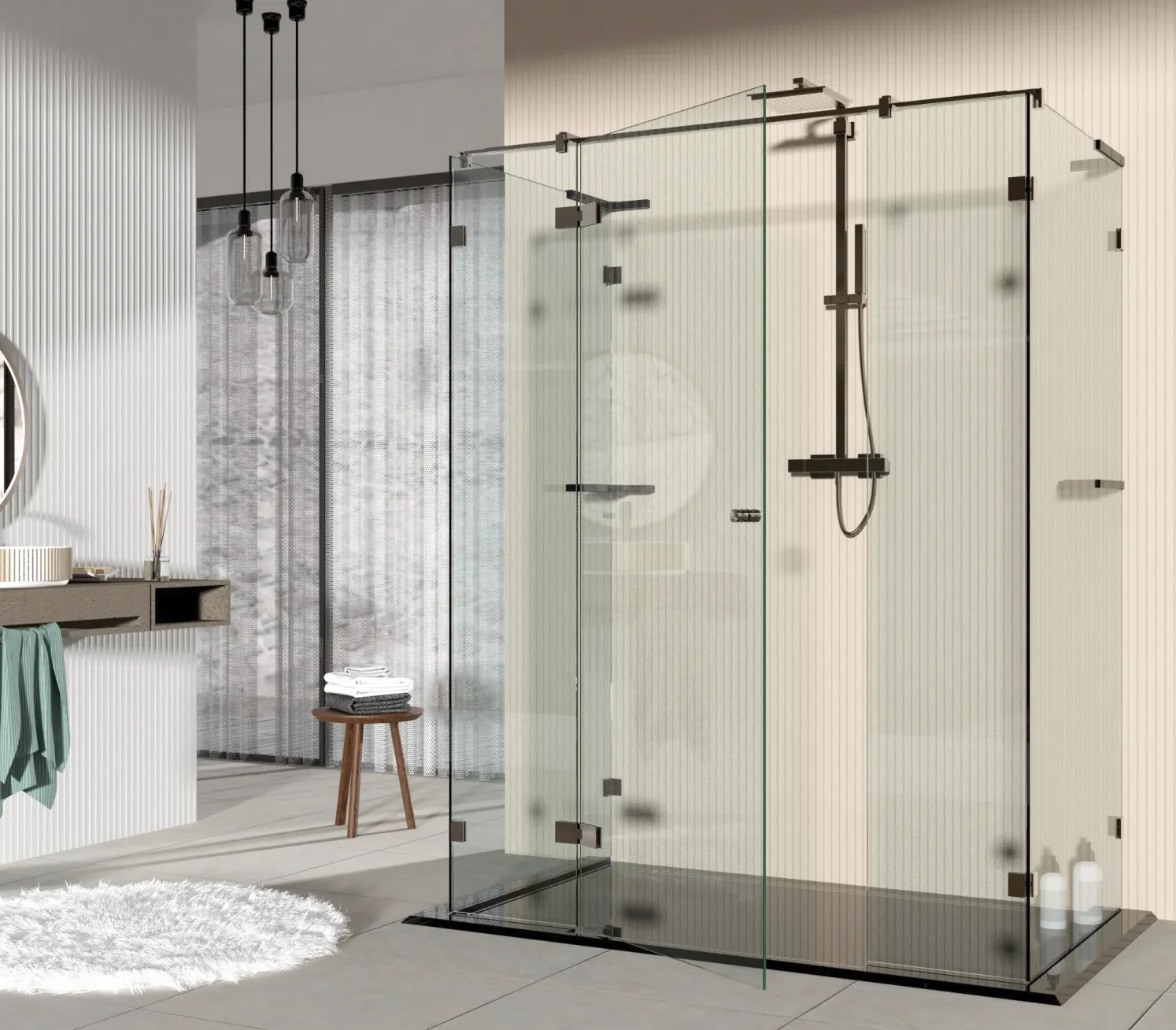
Do you want to make a glass balustrade for a staircase, loft, balcony, roof terrace or veranda? Then you not only choose the right safety glass, but also the right mounting system. The two most commonly used systems are glass clamps and point holders, both of which can be found with us balustrade fitting. Glass clamps hold the window between uprights or posts. Point holders go through holes in the glass and are attached to a wall, floor structure, stair rail or concrete edge.
The short selection aid is simple: choose glass clamps if you want to place glass between posts without holes in the glass. Choose point holders if you want a sleek, floating look and are mounting the glass on the side of a structure. In this article we explain what the difference is, when to choose which system and what you should pay attention to when mounting on wood, steel and concrete.
Rule of thumb: glass between posts without holes = glass clamps. Floating against a structure via pre-drilled holes = point holders.
What are glass clamps?
Glass clamps are metal clamps that you use to secure a glass plate to uprights, posts or a frame. The glass plate is placed between the clamps and held firmly in place by rubber inlays. You usually do not need to have holes made in the glass with glass clamps. That makes this system relatively simple and popular for balustrades, windbreaks and partitions.
Glass clamps are often used for:
- stair railings
- void balustrades
- balcony railings
- windshields
- verandas
- terrace partitions
- glass fencing between posts
The system is especially useful when wooden, steel or stainless steel uprights are already present.
How do glass clamps work?
A glass clamp usually consists of:
- a metal clamp housing
- rubber inlays
- a mounting bolt
- clamp screws
- sometimes a locking pin or extra security
The clamp is first mounted on a post or upright. Then place the glass plate between the rubbers and tighten the clamp. The rubbers prevent metal from directly touching glass and provide grip. The glass is therefore not pierced, but clamped. This is an important advantage, because glass with holes must be produced precisely in advance. With glass clamps you have a little more leeway during installation.
Advantages of glass clamps
- usually no holes in glass required
- suitable for mounting between posts
- relatively easy installation
- Can be combined well with wooden, steel or stainless steel uprights
- glass is easier to replace
- minor adjustments are possible
- neat and solid appearance
For many DIY projects, glass clamps are more accessible than point holders because the sizing is less prone to error.
Disadvantages of glass clamps
- you need uprights or poles
- the posts remain visible
- the appearance is less minimalistic than with point holders
- the construction must be sufficiently stiff
- not every clamp is suitable for every glass thickness
- When used outdoors, you should pay attention to material and corrosion resistance
Do you want a completely floating glass wall without poles in sight? Then point holders are often nicer.
What are point holders?
Point holders, also called glass knobs or spacers, are round mounting points with which glass is mounted to the side of a structure. The holder goes through a hole in the glass and is anchored in the underlying construction. At the front you usually only see a round stainless steel button.
Point holders are often used for:
- glass balustrades along stairs
- voids
- balconies
- platforms
- concrete floor edges
- steel stair cheeks
- modern interiors
- floating glass constructions
The result is sleek and minimalist. The glass plate seems to hang almost freely in front of the structure.
How do point holders work?
With point holders, the glass plate is not clamped, but attached via drilled holes. This means that the glass must be provided with precisely placed holes in advance at the factory. Subsequent drilling of holes in hardened or laminated safety glass is not possible. You can therefore immediately assemble the bores for your point holders with your custom glass.
A point holder usually consists of:
- a threaded rod or bolt
- a spacer
- plastic or rubber protection
- a cover
- mounting in wall, concrete, wood or steel
The attachment must be very strong, because the forces on point holders can be great. This is especially important for balustrades.
Benefits of point holders
- very sleek and modern
- no posts or uprights required
- glass seems to float
- suitable for mounting against the side of a staircase or floor
- robust mounting with correct anchoring
- popular in modern homes and offices
- ideal when you want to see as little batter as possible
Point holders are often the best choice for a luxurious, minimalist balustrade.
Disadvantages of point holders
- holes in the glass are mandatory
- holes must be exactly right in advance
- mounting is less forgiving
- the surface must be very strong
- usually more difficult for DIY
- measuring incorrectly can be expensive
- not every wall or beam is suitable
- constructive control is often wise
So point holders are nice, but technically more critical.
Glass clamps vs. point holders: overview
| Attribute | Glass clamps | Point holders |
|---|---|---|
| Confirmation | Glass is clamped | Glass is attached via holes |
| Need holes in glass | Usually not | Yes |
| Mounting location | Between posts or uprights | Against side of construction |
| Appearance | Classic, robust, visible fittings | Sleek, modern, floating |
| Difficulty mounting | Average | Higher |
| Setting space | Something more | Limited |
| Posts needed | Yes, usually | No |
| Best surface | Wood, steel, stainless steel uprights | Concrete, steel, sturdy construction |
| Replacing glass | Relatively simple | More difficult |
| Suitable for DIY | More often yes | Only with good preparation |
When do you choose glass clamps?
Choose glass clamps when you want to place glass between posts, uprights or a frame. Glass clamps are especially suitable if:
- you already have uprights
- you don't want holes in the glass
- you want to keep installation a little easier
- you want to be able to replace glass more easily later
- you like a robust appearance
- you make a windbreak or patio fence
- your balustrade is between wooden or metal posts
Glass clamps are a practical choice for many verandas, terraces, balconies and stairs.
When do you choose point holders?
Choose point holders when you want a sleek, modern look and mount the glass directly against a structure. Point holders are especially suitable if:
- you don't want any poles in sight
- you mount glass against a concrete edge
- you mount glass against a steel stair trellis
- you want a floating look
- the construction is strong enough
- you can measure very accurately
- the drill holes can be precisely determined in advance
Point holders are popular for modern stairs, voids and balconies where the balustrade must remain as transparent as possible.
Which glass do you use?
Always use safety glass for balustrades. Which type and thickness is needed depends on the situation. If you want to know exactly what the difference is between the types, read tempered or laminated glass and what glass thickness you need.
Which glass for glass clamps?
Laminated safety glass is often used for glass clamps. This is important because the glass must stay together if it breaks. NB:
- do not use standard float glass
- do not use arbitrary glass thickness
- check whether the clamp is suitable for your glass thickness
- use the correct rubber inlays
- take into account indoor or outdoor use
- check whether the construction must be fall-proof
For balustrades, it is wise to always ask for advice about the correct glass structure.
Which glass for point holders?
With point holders you usually use laminated safety glass with pre-drilled holes, and for higher loads you often use tempered-laminated glass. The exact glass structure depends on the application, height, mounting and load. Important:
- holes must be made at the factory
- the position of the holes must be exactly correct
- holes cannot be moved after production
- the distance to the glass edge must be correct
- the glass must match the type of point holder
- the construction must be strong enough
Therefore, measure extra carefully. With point holders, a deviation of a few millimeters quickly becomes a problem.
Mounting per surface
Mounting on wood
Glass clamps can be easily mounted on sturdy wooden posts, as long as the wood is strong enough and the screws have sufficient grip. NB:
- use solid and healthy wood
- avoid weak or rotten posts
- use suitable stainless steel screws
- pre-drill neatly
- make sure the clamps align exactly
- check that the post cannot twist
Point holders in wood are more critical. A regular wood screw is often not enough for heavy lateral loads. For heavy glass constructions, through-and-through mounting with threaded rods, washers and lock nuts is often more reliable.
Mounting on steel or stainless steel
When mounting on steel or stainless steel, you can often securely attach glass clamps by drilling holes and tapping thread. Blind rivet nuts are sometimes used. NB:
- use suitable mounting material
- prevent contact corrosion
- ensure accurate alignment
- use clamps of suitable quality
- choose stainless steel or corrosion-resistant material outside
For point holders on steel, the stair trellis or construction is usually suitable if it is sufficiently thick and strong. The load must be distributed properly.
Mounting on concrete
Concrete is often a good surface for point holders, provided the anchoring is carried out correctly. chemical anchors are often used for point holders in concrete. These ensure a strong connection between threaded rod and concrete. NB:
- do not use standard nylon plugs for heavy balustrades
- drill at the correct depth
- make drill holes dust-free
- use appropriate chemical anchorage
- take edge distances into account
- check whether the concrete is strong enough
When in doubt, constructive advice is wise. A glass balustrade is a safety feature, not a decorative panel.
How do you measure the glass?
Accurate measuring is important with both systems. For the basics, also see measure glass.
Measuring for glass clamps
With glass clamps, you mainly measure the space between the uprights and the desired height of the glass. NB:
- keep sufficient clearance between glass and post
- check the distance between the clamps
- make sure all posts are straight
- measure at multiple heights
- take into account the rubbers in the clamps
- check whether the glass remains clear of the floor or wall
Because the glass is not attached with holes, you have a little more leeway than with point holders. Still, the size must be accurate.
Measuring for point holders
With point holders you have to measure much more precisely. Not only the glass size must be correct, but also the position of the drill holes. You must determine:
- total glass width
- total glass height
- number of point holders
- diameter of the holes
- distance from the holes to the glass edge
- center-to-center distance between holes
- position relative to the floor, stairs or wall
- desired height of the balustrade
Always make a clear drawing with all dimensions in millimeters. Please check the drawing several times before ordering.
Common mistakes
- Choose the wrong system — glass clamps and point holders have a different appearance and mounting method. Choose not only on appearance, but also on construction.
- Use standard glass — use safety glass for balustrades. Ordinary glass is not suitable.
- Forgot holes in point holders — point holders require holes in the glass; these must be made in advance.
- Positioning holes incorrectly — with point holders, a small measurement error can mean that the window does not fit.
- Use too weak a surface — a balustrade must be able to absorb forces. Weak wooden beams or bad plugs are unsafe.
- Do not take outdoor use into account — outside you have to deal with rain, wind, temperature and corrosion; choose suitable material.
- Only look at the fittings — safety depends on the combination: glass, fittings, surface and mounting.
Which look suits your project?
Glass clamps give a slightly more technical and robust image. You can see the uprights and clamps more clearly. This goes well with verandas, terraces, classic balustrades and practical partitions. Point holders give a sleeker and more minimalist result. You mainly see glass and small round mounting points. This fits well with modern interiors, stairs, voids and balconies.
| Desired appearance | Best choice |
|---|---|
| Sleek and floating | Point holders |
| Robust and practical | Glass clamps |
| As few posts as possible | Point holders |
| Easier installation | Glass clamps |
| Between existing posts | Glass clamps |
| Against concrete edge | Point holders |
| Modern staircase | Point holders |
| Verandah or terrace | Glass clamps |
Checklist before you order
- Do I choose glass clamps or point holders?
- Is the surface strong enough?
- Do I need safety glass?
- Which glass thickness suits the system?
- Is it inside or outside?
- Are the uprights straight?
- Should there be holes in the glass?
- Are the borehole positions correct?
- Is the fitting suitable for the glass thickness?
- Is the mounting corrosion resistant?
- Is the structure fall-proof?
- Have I checked all dimensions in millimeters?
Conclusion
Glass clamps and point holders are both suitable for glass balustrades, but they suit different situations. Choose glass clamps if you want to place glass between posts or uprights, do not want holes in the glass and are looking for a practical installation. Choose point holders if you want a sleek, modern and almost floating look, where the glass is attached to the side of a sturdy construction.
Safety is the most important thing with both systems. Use suitable laminated safety glass, check the surface and measure carefully. Especially with point holders, the glass size and drill holes must be exactly correct.
View our balustrade systems with glass clamps and point holders or have your custom glass put together. Are you unsure about the glass structure or mounting? Please feel free to contact us for advice about your project.