
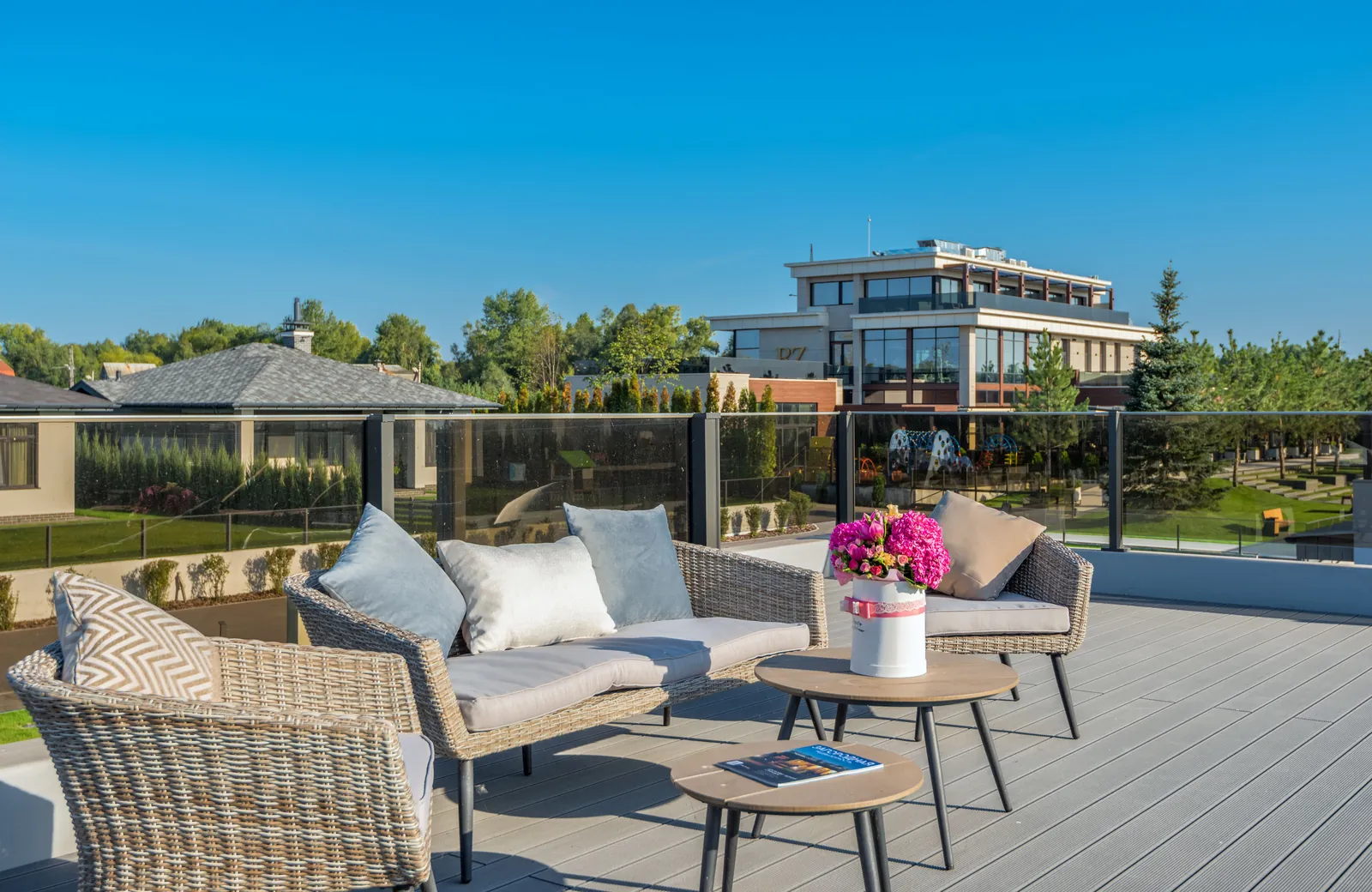
A glass windshield provides shelter without obscuring your view. That is why you often see glass on terraces, balconies, roof terraces, verandas and in gardens: you are out of the wind, but retain light and view. The short rule is: always use safety glass for a glass windshield. You usually choose tempered glass or tempered laminated glass, depending on height, mounting, wind load and fall risk.
In this article we explain which glass is suitable for a windshield, which thickness to choose and what you should pay attention to when mounting and safety.
Rule of thumb: always use safety glass. In a sheltered garden, tempered glass is often sufficient; For balconies, roof terraces, height differences or risk of falling through, choose laminated or tempered-laminated glass.
What is a glass windshield?
A glass windshield is a fixed or movable sheet of glass that blocks wind. The glass is usually placed in profiles, clamps or uprights. The goal is to create more comfort without installing a closed wall.
Glass windshields are used, among other things, for:
- garden terraces
- balconies
- roof terraces
- verandas
- catering terraces
- swimming pools and lounges
- outdoor kitchens and beach pavilions
- balcony screens and boundary fences
Why choose glass as a windbreak?
Glass is popular because it provides shelter without blocking the view. A wooden or metal fence blocks the wind, but often makes the room darker and smaller. Glass remains open and light.
Advantages of a glass windshield:
- preservation of view and plenty of light
- modern look and good wind protection
- durable material, easy to clean
- suitable for customization
- Combines well with stainless steel, aluminum or black profiles
- suitable for garden, balcony and terrace
Glass is a logical choice, especially for terraces with a beautiful view.
Which glass do you use for a windshield?
For a windshield, use safety glass. The most commonly used options are tempered glass, laminated glass and tempered-laminated glass. Which choice is best depends on the application.
Never use standard float glass for a windshield. Outside, glass has to deal with wind, impacts and temperature differences.
| Glass type | Breaking behavior | When suitable |
|---|---|---|
| Tempered glass | Breaks into small, blunt grains | Sheltered garden and patio screens |
| Laminated glass | Shards stick to foil | Fall risk, height difference |
| Tempered-laminated glass | Strong and stays together even if broken | Balconies, roof terraces, high loads |
You can read more background in tempered glass: what is it? and laminated glass: what is it?.
Tempered glass for windshields
Toughened glass is often used for windshields. It is stronger than normal glass and can withstand impacts and temperature differences better. When it breaks, it shatters into small granules — safer than sharp shards.
Advantages: strong, suitable for outdoor use, safe breaking behavior, easy to combine with clamps, sleek appearance and available in different thicknesses. The disadvantage is that the glass does not remain in place as a screen if broken. That is why laminated or tempered-laminated glass is often better in case of a fall risk or height difference.
Laminated glass for windshields
Laminated glass consists of two or more panes of glass with foil in between. If the glass breaks, the shards remain stuck to the foil. This is especially important if the glass should not fall open immediately if it breaks.
Laminated glass is interesting for balconies, roof terraces, height differences, fall risk, public places and terraces with frequent use. So it is not only safer in the event of breakage, but can also be important for constructive safety.
Tempered laminated glass for windshields
Tempered laminated glass is often the best choice for higher wind screens, balconies, roof terraces and places with extra load. It combines the strength of tempered glass with the film of laminated glass.
Advantages: strong, safe fracture behavior, stays together better in the event of breakage, suitable for higher loads and better against the risk of falling through. It is more expensive than single tempered glass, but is often the better choice for risky applications.
What thickness of glass for a windshield?
The correct thickness depends on height, width, mounting and wind load. A low windbreak in a sheltered garden requires something different than a high screen on a roof terrace.
| Glass thickness | Application |
|---|---|
| 8 mm hardened | Low or smaller screens |
| 10 mm hardened | Commonly used thickness for patio screens |
| 12 mm hardened | Larger or higher screens |
| 44.2 layered | Situations where glass must remain in place when broken |
| 55.2 layered | Heavier applications |
| Hardened-Laminated | With high loads or risk of falling through |
Use this as a guide: the correct thickness should always match the construction and mounting. You can find more help with choosing in what glass thickness do I need?.
Wind load: why is that important?
A windshield catches wind. The higher and wider the screen, the greater the load. Wind load is therefore one of the most important factors.
Wind load depends on:
- height and width of the screen
- location: open or sheltered location
- balcony or roof terrace
- coastal area and height above ground level
- attachment and number of support points
A screen on a roof terrace receives much more wind than a screen in a sheltered garden. The choice of glass and mounting must be tailored to this.
Windbreak in the garden
In a garden, a glass windbreak is often intended to make a seating area more comfortable. The wind load is usually lower than on a balcony or roof terrace, but still important. NB:
- is the screen exposed to the wind, or against a wall or hedge?
- how high will the screen be?
- is the glass placed in uprights?
- is the surface firm enough?
- is there a risk of impact from furniture or children?
Tempered glass is used for many garden applications, often in combination with sturdy uprights or profiles.
Windbreak on balcony
A balcony requires more attention than a garden. There is often a height difference and therefore a possible risk of falling. Then the safety requirement is higher. For balconies, pay attention to fall protection, height of the screen, attachment to the balcony edge, wind load, glass structure, structural substrate, rules of the homeowners' association or landlord and view and privacy.
For balconies, tempered-laminated glass is often wise, especially if the screen also functions as a partition or balustrade.
Windbreak on roof terrace
A roof terrace is extra sensitive to wind. The screen is often high and free, so the wind load can be considerable. The following are important: strong mounting, the correct glass structure (tempered-laminated glass), wind load, structural surface, height of the screen, edge distance and safety in the event of breakage.
Do not simply place standard glass in loose clamps on a roof terrace. This must be carefully tailored to the situation.
Windbreak for catering
Glass wind screens are often used on catering terraces. They provide guests with shelter while the terrace remains open. Important are: intensive use, impact load, fixed or movable installation, safety for guests, cleaning, regulations, stability, vandalism resistance and the combination with parasols or heaters.
For catering applications, sturdy tempered or tempered-laminated glass with robust profiles is often chosen.
Fixed or movable windshield?
A windbreak can be permanently mounted or movable.
- Fixed windbreak — attached to floor, wall, balustrade or uprights. Advantages: stable, sleek result, suitable for permanent installation, better with higher screens and heavier glass.
- Movable windshield — is often in separate feet or modules. Advantages: flexible, useful for catering, can be moved for seasonal use, no permanent installation. Disadvantage: movable screens must be extra stable, especially in windy conditions.
Attaching glass windshields
The mounting is just as important as the glass. Strong glass in poor clamps is not safe.
Commonly used mountings are glass clamps, uprights, U-profiles, floor profiles, post systems, balustrade profiles, aluminum frames, stainless steel clamps and black profiles — can be found with us balustrade fittings with glass clamps, point holders and profiles. NB:
- suitable for the glass thickness and for outdoor use
- corrosion resistant and sufficient grip
- rubbers between glass and metal
- correct anchoring and sufficient support points
Glass should not clamp directly hard against metal without rubber or protection.
Glass clamps for windshields
Glass clamps give an open appearance. They are often used for low windbreaks or screens between uprights. Please note: clamps must match the glass thickness, the number of clamps must be sufficient, the surface must be sturdy, rubbers must be placed correctly and the wind load must be taken into account.
Small clamps are sometimes insufficient for high screens or heavy wind loads. Then a profile or stronger system is better. Are you unsure between systems? Read glass clamps or point holders for a balustrade.
Profiles for windshields
Profiles provide more support than loose clamps. A U-profile or balustrade profile holds the glass over a larger part. Advantages: stronger support, sleek finish, suitable for larger glass plates, better load distribution and less point load on the glass. Particularly interesting for higher screens, balconies and roof terraces.
Clear glass, frosted glass or smoked glass?
A windshield does not always have to be completely clear. You can also choose privacy or appearance.
| Type of glass | Effect |
|---|---|
| Clear glass | Maximum view |
| Extra clear glass | Less green tint |
| Frosted glass | More privacy |
| Smoked glass | Luxurious dark appearance |
| Bronze glass | Warm tone |
| Colored glass | Design accent |
| Figure glass | Decorative and partly privacy |
Clear glass is usually the most popular choice for terraces with a view. Frosted glass can be interesting for balconies with a view.
Frosted glass for privacy
Frosted glass allows light to pass through, but limits direct vision. This is useful on balconies, at neighbors' homes or in gardens where privacy is important. Suitable for balcony partitions, garden screens, roof terraces, property boundaries, catering and swimming pools. Please note: frosted glass makes stains and dirt visible more quickly and must be cleaned regularly outside.
Smoked glass or bronze glass outside
Smoked glass and bronze glass give a luxurious look. They are mainly chosen for modern gardens, verandas and exclusive terraces. Advantages: luxurious appearance, less bright light, more privacy than clear glass and beautiful with black or bronze profiles. Disadvantage: the appearance becomes darker and the glass can absorb more heat than clear glass.
Edge finishing of a glass windshield
Glass edges are often visible on windshields. That is why a neat edge finish is important. Commonly used edge finishes are sharp edges ground, flat ground, flat poly ground and rounded corners.
For visible edges, flat poly cut is often the best: the edges are smooth and neatly finished. When used outdoors, edges must be well protected against impacts. More about this in edge finishing of glass: sharp edges or ground?.
Holes and recesses
Sometimes holes or recesses are needed for mounting, such as point holders, special clamps or fittings. With tempered glass, holes and recesses must be made before tempering; Drilling or grinding afterwards is not possible. Drillings, recesses and edge finishes are therefore included in your custom glass.
Determine in advance: type of mounting, position and diameter of holes, distance to the glass edge, cutouts, corner roundings and glass thickness. Always use fittings intended for glass.
Glass weight of a windshield
Glass is heavy. Take transport and assembly into account. Glass weighs approximately 2.5 kg per m² per millimeter of thickness.
Example — 1000 × 1800 mm windshield in 10 mm tempered glass:
1.0 × 1.8 = 1.8 m² → 1.8 × 10 × 2.5 = 45 kg
Example — 1200 × 2000 mm screen in 12 mm glass:
1.2 × 2.0 = 2.4 m² → 2.4 × 12 × 2.5 = 72 kg
Large glass plates must be installed with several people and suitable tools. Calculate your own screen with calculate glass weight.
Maintenance of a glass windshield
An outdoor windshield becomes dirty due to rain, dust, leaves, pollen and deposits. Maintenance tips:
- rinse off dirt first
- use a soft sponge or cloth and a mild cleaning agent
- avoid abrasives
- dry with a squeegee or microfiber cloth
- check clamps, profiles and rubbers
- remove lime or salt deposits in a timely manner
- check whether fastenings are still sturdy
Salt deposits can form more quickly at the sea. Stainless steel and aluminum fittings must then be extra well maintained.
Common mistakes with glass windshields
- Use normal glass — float glass is not suitable; use safety glass.
- Underestimate wind load — a screen catches a lot of wind, especially on balconies and roof terraces.
- Only look at glass thickness — mounting and surface are just as important.
- No laminated glass if there is a height difference — if there is a risk of falling, tempered glass alone is often not enough.
- Using incorrect clamps — clamps must match glass thickness, weight and application.
- Clamp glass directly to metal — always use rubber or protective material.
- Underestimating weight — a large sheet of glass can weigh tens of pounds.
Selection aid: which glass for a windshield?
| Situation | Best choice |
|---|---|
| Sheltered garden | Tempered glass |
| Terrace at home | 10 mm tempered glass |
| Balcony | Tempered-laminated glass |
| Roof terrace | Tempered-laminated glass with sturdy profiles |
| Catering terrace | Tempered or tempered-laminated glass |
| More privacy | Frosted glass |
| Luxurious appearance | Smoked glass or bronze glass |
| Fall through risk | Laminated or tempered-laminated glass |
| High wind load | Heavier glass structure and strong profiles |
| Movable screen | Sturdy system with safety glass |
Does the screen also work as a partition that people can lean against? Please also pay attention to the rules regarding safety glass under 85 cm.
Checklist before you order
- Will the screen be installed in the garden, balcony or roof terrace?
- Is there a risk of falling through?
- How high and wide will the glass be?
- Is the location sheltered or open, and what wind loads can be expected?
- Do you choose tempered, laminated or tempered-laminated glass, and what thickness?
- Which mounting system do you use, and is it suitable for outdoor use?
- Can the surface support the screen?
- Are rubbers and protection present?
- Do you want clear glass, frosted glass or smoked glass?
- Are edges visible and are holes or recesses necessary?
- Can the glass be mounted safely?
Measure your screen properly using measure glass.
Conclusion
A glass windbreak is a great way to create shelter without losing views and light. It is suitable for gardens, terraces, balconies, roof terraces and catering. Always use safety glass: tempered glass is suitable for many sheltered garden situations, and for balconies, roof terraces, height differences or risk of falling through, laminated or tempered-laminated glass is usually the better choice.
Don't just pay attention to the glass thickness. Wind load, mounting, surface, glass weight and safety together determine whether the screen is suitable.
Read more and order:
- Safety glass — tempered and laminated glass for windshields
- Balustrade — if the screen also works as a partition
- Tempered glass: what is it? and laminated glass: what is it?
- What thickness of glass do I need?
Need a custom windshield? Create your glass via custom glass and choose the type, thickness and edge finish yourself.