
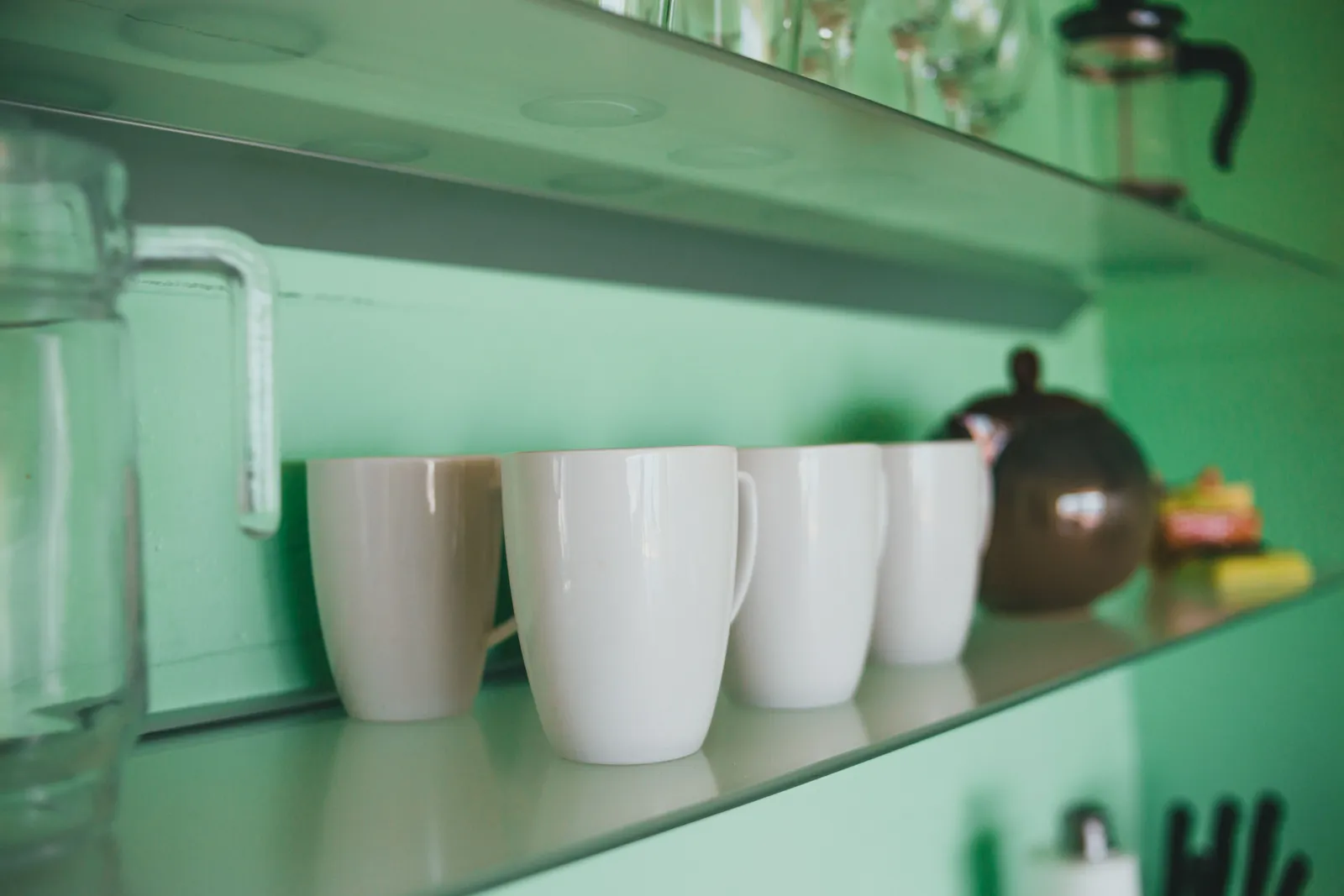
A glass wall shelf is a sleek and light way to present or store items. You often see glass shelves in bathrooms, display cabinets, shops, kitchens and interiors where a modern look is desired. Glass looks spacious, lets light through and suits almost any style. A wooden plank can appear massive, while glass is visually much less present.
The short rule is: for a glass wall shelf, usually choose tempered glass with a neatly cut edge. The correct thickness depends on the length, depth, load and type of supports. In this article we explain what thickness of glass you need, which edge finish you choose, which supports fit and what you should pay attention to during installation.
Rule of thumb: choose tempered glass and realize that the supports and the wall are just as important as the glass thickness. A thick glass plate on poor supports is not safe; a well-supported plank of 8 mm works well for light items.
What is a glass wall shelf?
A glass wall shelf is a glass plate that is mounted horizontally to the wall. The shelf is used to put things on, such as decoration, toiletries, glasses, books, products or accessories.
Glass wall shelves are often used in:
- bathrooms;
- Toilets;
- kitchens;
- display cabinets;
- shops and showrooms;
- living rooms and alcoves;
- dressing tables;
- offices and catering establishments.
The advantage of glass is that it looks visually light and keeps the wall or products behind it visible.
Why choose a glass wall shelf?
A glass shelf has both practical and aesthetic advantages:
- sleek appearance;
- allows light to pass through;
- easy to clean;
- moisture resistant, so suitable for the bathroom;
- customization possible;
- combines well with stainless steel, black or chrome fittings;
- available in different thicknesses;
- suitable for showcases and shops;
- looks less heavy than wood.
A glass shelf is especially nice when you want to keep the wall or the products behind it visible.
Which glass do you use for a wall shelf?
For a wall shelf, preferably use tempered glass. Tempered glass is stronger than normal glass and has safer breaking behavior. A wall shelf can be stressed by objects, impacts or incorrect use. That is why standard float glass is usually less sensible.
Tempered glass is suitable because it:
- is stronger than normal glass;
- better resistant to impacts;
- breaks more safely (in small, blunt grains);
- suitable for visible applications;
- can be easily combined with shelf supports;
- can be neatly tailored.
Be sure to use tempered glass if the shelf will be in a bathroom, shop, kitchen or heavily used area. You can find more about safety glass in our category.
Can you use normal glass?
Normal glass can be used in some light applications, for example in a small display cabinet that receives little load. Still, tempered glass is usually better.
Normal glass is less suitable when:
- the shelf hangs freely;
- heavier items are placed on it;
- the shelf hangs in a bathroom;
- the board can be easily hit;
- children can join them;
- the plank is longer or deeper;
- the edges are visible and touchable.
For custom wall shelves, tempered glass is often the safer and more durable choice.
What thickness of glass for a wall shelf?
The correct thickness depends on the size and load. The longer and deeper the shelf, the thicker the glass usually needs to be.
| Glass thickness | Application |
|---|---|
| 6 mm | Small, light planks |
| 8 mm | Commonly used thickness for bathroom and interior |
| 10 mm | Sturdier wall shelves |
| 12 mm | Larger or more heavily loaded planks |
| 15 mm | Luxurious heavy appearance or large span |
For most wall shelves, 8 or 10 mm tempered glass is a good choice. For longer planks or heavier loads, 10 or 12 mm is more sensible. Are you unsure about the thickness in general? Then read which glass thickness you need.
Guidelines per application
| Application | Recommended direction |
|---|---|
| Small bathroom shelf | 6–8 mm tempered glass |
| Wall shelf for decoration | 8 mm tempered glass |
| Kitchen shelf for glasses/spices | 8–10 mm tempered glass |
| Display shelf | 6–8 mm, depending on load |
| Shop presentation | 10–12 mm tempered glass |
| Long wall shelf | 10–12 mm tempered glass |
| Heavy load | Have thickness and supports checked |
Use this as a general guideline. The exact choice depends on length, depth, number of supports and the weight on the shelf.
How heavy is a glass wall shelf?
Glass weighs approximately 2.5 kg per m² per millimeter of thickness. A short calculation helps to estimate the load:
Glass shelf of 800 × 250 mm in 8 mm thick glass → 0.8 × 0.25 = 0.20 m² → 0.20 × 8 × 2.5 = 4 kg
Glass shelf of 1200 × 300 mm in 10 mm thick glass → 1.2 × 0.3 = 0.36 m² → 0.36 × 10 × 2.5 = 9 kg
Added to this is the weight of the items on the shelf. The wall and supports must therefore be able to support more than just the glass. Do you want to calculate this exactly? Then use our explanation about calculate glass weight.
How much weight can a glass wall shelf support?
The glass thickness is not the only factor that determines the load-bearing capacity. Important are:
- glass thickness;
- length of the plank;
- depth of the shelf;
- type of glass;
- number of carriers;
- distance between carriers;
- quality of the wall;
- type of confirmation;
- weight of the items;
- load distribution.
A thick glass plate on poor supports is not safe. Conversely, a well-supported plank of 8 mm can work well for light items.
The importance of good shelf supports
The carriers are at least as important as the glass. They absorb the load and distribute the weight to the wall. Commonly used confirmations:
- clamp board carriers;
- shelf supports with rubber;
- U-profiles;
- pin supports;
- niche supports;
- blind shelf supports;
- display cabinet supports;
- corner supports.
Always use carriers that are suitable for glass. Glass should not clamp directly hard against metal without protection. Rubbers or plastic inlays prevent tension and damage. You can find glass shelf supports and furniture fittings at display and furniture fittings.
How many porters do you need?
For short glass shelves, two supports are often enough. For longer planks, three or more supports are advisable.
| Shelf length | Number of carriers |
|---|---|
| Up to 600 mm | 2 carriers |
| 600–1000 mm | 2 to 3 carriers |
| 1000–1500 mm | 3 carriers |
| More than 1500 mm | 3 or more depending on tax |
For heavy loads or deep shelves, you prefer to install additional supports. This reduces deflection and makes the plank more stable.
Depth of a glass wall shelf
The depth determines how much moment is applied to the mounting. A deep plank pulls harder on the wall mounting than a shallow plank.
| Depth | Application |
|---|---|
| 100–150 mm | Narrow decoration shelf |
| 150–200 mm | Bathroom shelf |
| 200–250 mm | General wall shelf |
| 250–300 mm | Kitchen or display |
| 300+mm | Heavier application, good support |
The deeper the shelf, the more important strong supports and good wall mounting become.
Glass shelf per room
In the bathroom
A glass wall shelf is popular in bathrooms. Glass is moisture resistant and easy to clean. Applications include a shelf above the sink, in the shower corner, above the toilet, near the mirror or in a niche.
Please note in the bathroom:
- tempered glass;
- Stainless steel or moisture-resistant fittings;
- limescale formation;
- sealant seams;
- rounded corners;
- safe edge finishing;
- sufficient carrying capacity.
Do not use untreated metal fasteners that can rust. The following also applies to shower and bath applications: choose moisture-resistant material.
In the kitchen
In the kitchen, a glass shelf can be nice for spices, glasses, mugs or decoration. Glass is hygienic and easy to clean. NB:
- load due to tableware;
- grease and dirt;
- distance to the hob;
- wall material;
- sturdy carriers;
- cleanability;
- heat sources.
Do not hang a glass shelf too close to a gas flame or direct heat source, unless the situation has been assessed as suitable.
In a display case
Glass shelves are often used in display cabinets. These allow light to pass through, making products or collectibles more visible. With display shelves, please note:
- exact size;
- thickness;
- load per shelf;
- carriers in the closet;
- edge finishing;
- clear or extra clear glass;
- safety when opening and closing.
6 or 8 mm glass is often used for display cases, depending on the length and load.
In store or showroom
In stores, glass shelves are often used for product presentation. Load and safety are extra important here, because customers come close and products are regularly moved. NB:
- tempered glass;
- sufficient thickness;
- rounded corners;
- strong carriers;
- clear maximum load;
- stable mounting;
- cleaning;
- scratch sensitivity.
For commercial applications, 10 or 12 mm tempered glass is often a sensible choice.
Edge finishing of a glass wall shelf
With a glass wall shelf, the edges are visible and touchable. That is why the edge finish is important.
| Edge finishing | When to choose? |
|---|---|
| Sharp edges ground off | Basic finish |
| Flat ground | Functional and neat |
| Flat poly cut | Nice, smooth visible edge |
| Facet cut | Decorative and classic |
| Rounded corners | Extra safe and pleasant |
For wall shelves, flat poly cut is often the best choice. The edge feels smooth and looks neat. On the site this finish is called "Polished (platpoly)" and you choose it when putting together your custom glass.
Should corners be rounded?
Rounded corners are often wise for wall shelves, especially if the shelf is at eye level or walking height. They are useful for:
- bathroom shelves;
- children's bathrooms;
- narrow spaces;
- shops;
- places you walk past;
- shelves next to a mirror;
- shelves at doors.
A sharp corner can be annoying if you bump into it. A small radius makes the plank safer and more beautiful.
Clear glass or extra clear glass?
Standard glass has a light green tint. With thick glass plates you mainly see this at the edges. Extra clear glass has less green color cast and therefore looks more neutral and luxurious. Choose extra clear glass for:
- white bathrooms;
- bright interiors;
- a luxurious appearance;
- thick glass shelves;
- product presentation;
- minimalist decor.
For ordinary applications, standard clear glass is often fine. In luxurious interiors, extra clear glass can look neater.
Frosted or smoked glass for wall shelves
Glass shelves can also be made of frosted glass, smoked glass or bronze glass.
| Type of glass | Appearance |
|---|---|
| Clear glass | Light and neutral |
| Extra clear glass | Luxury and lack of color |
| Frosted glass | Softer and less transparent |
| Smoked glass | Dark and stylish |
| Bronze glass | Warm and classic |
| Colored glass | Striking design choice |
Smoked glass and bronze glass are often used in luxury interiors, cabinets and shops.
Technique: deflection, wall and holes
Can a glass wall shelf bend?
Yes, glass can bend slightly under load. That depends on length, thickness and weight on the board. Deflection occurs more quickly with long shelves, thin glass, few supports, deep shelves, heavy items and a large distance between the supports.
Do you want to limit deflection? Then choose:
- thicker glass;
- additional carriers;
- a shorter span;
- a shallower shelf;
- better support.
Where do you attach the shelf to?
The wall determines the load-bearing capacity. A strong glass plate is of little use if the carriers are poorly secured. Be careful with brick, concrete, plasterboard, wood, tiles, aerated concrete and metal stud walls.
Extra attention is required for plasterboard. Use suitable plugs or provide rear wood. Plasterboard without reinforcement is often not suitable for heavy glass shelves.
Do you install on tiles (bathroom or kitchen)? That's fine, but drill carefully:
- use a suitable tile drill;
- prevent cracks;
- do not drill too close to tile edges;
- use the correct plugs;
- check for pipes;
- seal where necessary;
- use moisture-resistant batter.
When in doubt, professional installation is wise.
Holes in glass for wall shelves
Sometimes holes are made in the glass shelf for special mounting. You choose drillings, recesses and corner rounding when putting together in the custom glass configurator. This must be done in advance, especially with tempered glass: after hardening you can no longer drill, grind or saw.
Therefore determine in advance:
- where the holes should be;
- the diameter of the holes;
- the distance to the edge;
- the type of confirmation;
- the position of the carriers;
- the desired corner rounding.
For many wall shelves, holes are not necessary because they are located in clamp or profile supports.
Installing a glass wall shelf
A glass shelf must be mounted flat, stable and tension-free. The general steps:
- Determine the exact position.
- Check whether the wall is suitable.
- Mark the supports level.
- Drill the holes.
- Install the plugs or mounting.
- Install the carriers.
- Place rubber or protection on the contact points.
- Carefully place the glass.
- Check whether the plank is stable.
- Secure the shelf according to the system.
Glass should not lie directly hard against metal or stone. Always use rubber or plastic protection.
Maintenance
A glass shelf is easy to clean. Use a soft cloth and mild detergent. Tips:
- do not use a scouring pad;
- avoid abrasives;
- dry with a microfiber cloth;
- remove limescale regularly;
- lift things instead of sliding them;
- check the carriers occasionally;
- carefully clean the edges.
Glass can scratch when sand, metal or rough materials slide over it.
Common mistakes with glass wall shelves
- Choose glass that is too thin — a long shelf of thin glass can bend or be fragile.
- Use poor carriers — the carriers largely determine safety.
- Do not check wall — drywall or poor walls may not have sufficient load-bearing capacity.
- Do not choose tempered glass — for free-hanging shelves, tempered glass is usually more sensible.
- Do not allow edges to be neatly ground — visible glass edges must be smooth and safe.
- Underestimate weight — glass is heavy before anything is placed on it.
- Use too few supports — long planks often require additional supports.
Selection aid: which glass shelf do you need?
| Situation | Best choice |
|---|---|
| Small bathroom shelf | 6–8 mm tempered glass |
| Standard wall shelf | 8 mm tempered glass |
| Longer plank | 10 mm tempered glass |
| Heavy load | 10–12 mm with additional supports |
| Luxurious appearance | Extra clear glass |
| Secure visible edges | Flat poly cut |
| Narrow space | Rounded corners |
| Shop presentation | 10–12 mm tempered glass |
| Showcase | 6–8 mm glass, depending on load |
| Dark design look | Smoked glass or bronze glass |
Checklist before you order
- Where will the shelf be hung?
- How long and deep is the plank?
- What will be on the shelf?
- What thickness of glass is needed?
- Do you choose tempered glass?
- What edge finish do you want?
- Do the corners need to be rounded?
- Do you want clear, extra clear, frosted or smoked glass?
- Which carriers do you use, and how many?
- Is the wall strong enough?
- Will the shelf be placed in a damp room?
- Are holes needed in the glass?
- Can the glass be mounted safely?
- Is the maximum load clear?
Do you measure the space yourself? Then first read how to measure glass, so that the measurements are exactly correct.
Conclusion
A glass wall shelf is a beautiful and practical solution for bathrooms, kitchens, showcases, shops and interiors. Glass looks light, is easy to clean and suits many styles. Preferably choose tempered glass for a wall shelf. For small, light planks, 6 or 8 mm is often sufficient; for longer or heavier planks, 10 or 12 mm is more sensible.
Pay attention not only to the glass thickness, but also to the supports, the wall mounting and the load — these together determine a safe shelf. In addition, ensure a neat edge finish, such as flat poly-sharpened edges and possibly rounded corners.
Read more about tempered glass, the correct glass thickness and edge finish. Ready to order? Create your shelf with custom glass or view our glass items.