
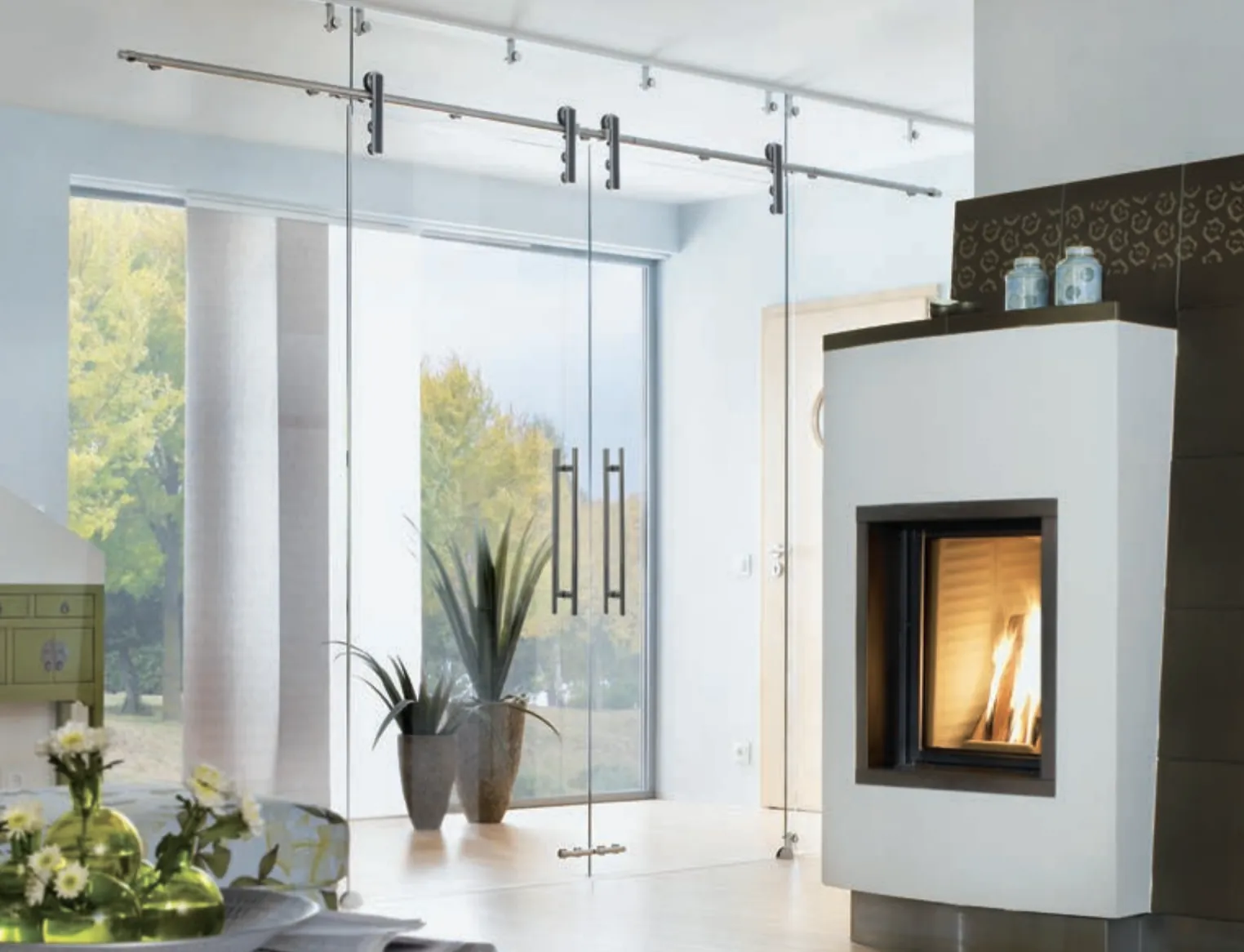
A glass door gives a room an open, light and modern look. You keep spaces separated from each other, but still retain view and light. That is why glass doors are widely used in homes, offices, bathrooms, shops and interior projects.
The short rule is: almost always choose tempered glass or tempered-laminated glass for a glass door, and pay particular attention to the correct glass size, thickness, fittings, direction of rotation, edge finish and safety. In this article you can read what types of glass doors there are, which glass to choose and what you should pay attention to when customizing.
Rule of thumb: always use safety glass and determine the fittings before production. Holes and recesses for hinges, locks and handles cannot be made in tempered glass afterwards — they must be known before tempering.
What is a custom glass door?
A custom glass door is a door that consists entirely or largely of glass and is made exactly according to your dimensions. The door can rotate, slide or pivot, depending on the system chosen.
Glass doors are often used as:
- interior door
- pivot door
- sliding door
- shower door
- office wall door
- shop door
- door between hall and living room
- door to the kitchen
- door in a glass wall
- door for a cupboard or niche
Because glass cannot simply be adjusted later, accurate measuring is important. Holes, recesses and hinge positions must be correct in advance.
Why choose a glass door?
A glass door has a different appearance than a wooden or steel door. The biggest advantage is that light continues to pass through the door.
Benefits of a glass door:
- more light in the house
- spatial appearance
- modern and luxurious finish
- suitable for small spaces
- Can be combined well with steel, wood or aluminum
- customization possible
- choice of clear, frosted, smoked glass or colored glass
- easy to clean
- suitable for homes and offices
A glass door is especially useful when you want to separate spaces without making them dark or closed.
Which glass do you use for a glass door?
For a glass door, use safety glass. In most cases this is tempered glass. Tempered glass is stronger than normal glass and has safer breaking behavior: when it breaks, it shatters into small grains instead of large sharp shards.
Tempered-laminated glass is used for some applications. That is laminated glass that is also toughened and consists of several layers with foil in between. If broken, the glass stays together better.
Never use standard float glass for a glass door. A door moves, experiences knocks and is in a walking route. So safety is important. You can find more background in Tempered glass: what is it? and Laminated glass: what is it?.
Tempered glass or tempered-laminated glass?
Tempered glass is sufficient for many glass interior doors. But in situations with extra risk, tempered-laminated glass may be better.
| Glass type | When to use? |
|---|---|
| Tempered glass | Standard glass interior door, shower door, pivot door |
| Laminated glass | When glass must stay together when broken |
| Tempered-laminated glass | For extra security, large doors or intensive use |
| Matte tempered glass | For privacy |
| Smoked glass tempered | For a luxurious dark look |
| Extra clear tempered glass | For less green glass tint |
The choice depends on the location, the fittings and the level of security you want.
What thickness of glass for a glass door?
The correct thickness depends on the door size, door type and fittings. Many glass doors are made of 8, 10 or 12 mm glass.
| Thickness | Application |
|---|---|
| 8 mm | Lighter interior doors and smaller doors |
| 10 mm | Commonly used thickness for glass doors |
| 12 mm | Large doors or extra sturdy appearance |
| Hardened-Laminated | Depending on system and application |
For a standard glass interior door, 10 mm tempered glass is often a good choice. For larger doors or pivot doors, 12 mm may be required, depending on the system. Always check what thickness the hardware supports — not every hinge or rail system is suitable for every glass thickness. Are you in doubt? Then read Which glass thickness do I need?.
Weight of a glass door
Glass is heavy and its weight is often underestimated. Glass weighs approximately 2.5 kg per m² per millimeter of glass thickness.
Example: a glass door of 900 × 2300 mm in 10 mm thick glass:
- 0.9 × 2.3 = 2.07 m²
- 2.07 × 10 × 2.5 = 51.75 kg (rounded ± 52 kg)
With 12 mm thick glass this becomes 2.07 × 12 × 2.5 = 62.1 kg. The fittings, wall, floor or rails must be able to support this weight. Calculate the weight of your door with the glass weight calculator.
Types of glass doors
There are different types of glass doors. The right choice depends on the space and how the door should open.
| Door type | Attribute |
|---|---|
| Revolving door | Hinges like a normal door |
| Pivot door | Rotates around a point in the floor and ceiling |
| Sliding door | Slides along the wall or in a rail system |
| Swing door | Can turn in both directions |
| Shower door | For bathroom or shower cabin |
| Door in glass wall | Part of glass wall or office wall |
Each door requires different fittings and other treatments in the glass.
Glass revolving door
A glass revolving door is similar in function to a normal door. The door hangs on hinges on one side and opens to the left or right.
Please note with a glass revolving door:
- direction of rotation
- hinge position
- handle
- any lock box
- frame or wall mounting
- glass thickness
- door weight
- clearance all around
The hinges are often visible on a glass door. Therefore, choose fittings that match the style of the room.
Glass pivot door
A pivot door revolves around a pivot point in the floor and the top. The hinges are therefore not on the side, but below and above the door. This gives a sleek and luxurious appearance.
Benefits of a glass pivot door:
- modern look
- can open in both directions
- no traditional frame required
- beautiful in wide passages
- suitable for steel look
- spatial effect
Please note: a pivot door requires suitable fittings and sufficient space to turn. The floor must also be suitable for the pivot hinge.
Sliding glass door
A sliding glass door is useful when you want little movement. The door slides along the wall or in a system.
Advantages: space-saving, modern appearance, suitable for wide openings, lots of light, beautiful with room dividers, suitable for cupboards or niches.
Please note:
- rail system
- wall strength
- door weight
- running wheels
- soft close
- handle or cup handle
- free space next to the opening
- floor or wall guidance
A sliding door needs space on the side to slide open.
Glass shower door
A shower door is a separate application. This door comes into contact with water, steam, lime and temperature differences. That is why tempered glass is almost always used for this.
Please note:
- glass thickness
- hinges
- water barrier
- magnetic strip
- sealing profiles
- direction of rotation
- limescale-resistant coating
- wall and floor level
- sealant seams
8 or 10 mm tempered glass is often used for shower doors. Do you want a complete wall with a door? Then read Custom shower enclosure: what to look out for?.
Clear glass, frosted glass or smoked glass?
A glass door does not always have to be completely clear. You can also choose frosted glass, smoked glass, bronze glass or colored glass.
| Type of glass | Effect |
|---|---|
| Clear glass | Maximum light transmission and openness |
| Extra clear glass | Less green tint |
| Frosted glass | More privacy |
| Smoked glass | Luxurious dark appearance |
| Bronze glass | Warm interior color |
| Figure glass | Decorative structure |
| Colored glass | Striking interior accent |
Frosted glass is often interesting for offices or bathrooms. Smoked glass or bronze glass are often chosen for modern interiors.
Extra clear glass on glass doors
Standard glass always has a light green tint. With thick panes of glass, this tint may be more visible, especially at the edges. Extra clear glass has less iron in the glass, making it look more neutral.
Extra clear glass is especially beautiful in minimalist interiors, white walls, light floors, luxurious finishes, thick glass plates and clear doors without a color cast. With smoked glass or frosted glass, extra clear glass is usually less important.
Edge finishing of a glass door
With a glass door, the edges are visible and touchable. That is why a good edge finish is important. You usually choose a neatly ground edge, such as:
- flat ground
- flat poly cut
- rounded corners
- possibly facet for decorative doors
For glass doors, flat poly cut is often the nicest choice. The edge is finished smoothly and neatly, making the door look safe and luxurious. Sharp unfinished edges are not suitable for a glass door. You can find more information in Edge finishing of glass: sharp edges or ground?.
Holes and recesses in a glass door
Glass doors often require processing for fittings. Think of holes, notches or recesses:
- hinge recesses
- lock case recess
- hole for handle
- recess for recessed handle
- pivot hinge positions
- mounting holes
- rounded corners
- recesses for fitting sets
You choose drillings, recesses and corner finishes when putting together in the custom glass configurator. These operations must be made before tempering the glass. After hardening, you can no longer drill, grind or saw the glass. That is why you must know in advance exactly which batter you are using.
Why choosing fittings in advance is important
The fitting determines where holes and recesses should be in the glass. Each hardware brand and system has its own dimensions. Therefore first choose:
- door type
- hinges
- handle
- lock
- rail system
- pivot system
- soft close
- sealing profiles
Then the glass can be drawn and produced correctly. Never just order a glass plate without knowing what fittings will be on it — there is a good chance that holes or recesses will be incorrect.
How do you measure a glass door?
Measuring depends on the type of door. A revolving door is measured differently than a sliding door or pivot door. However, there are general points of interest:
- measures in millimeters
- measure width in several places
- measure height in several places
- check whether the floor and ceiling are level
- check whether walls are square
- take play into account
- determine direction of rotation
- determine fitting positions
- check the weight
- check the opening where the door comes into
Glass should always have some play: a glass door should not be stuck. You can find a step-by-step plan in Measuring glass.
Clearance around a glass door
A glass door needs space to move properly. The exact clearance depends on the system. Pay attention to clearance at the floor, ceiling, frame, wall, another door, skirting boards, rails, hinges, handle and shower profiles.
Too little play causes problems when opening and closing. Too much play can cause drafts, noise or a less neat finish.
Determine the direction of rotation
With a glass revolving door you must determine in advance which direction the door opens and which side the hinges will be on. Think about the walking route, furniture, light switches, walls, opening inward or outward, left or right turning, safety and the available space.
With a pivot door you have to determine where the pivot point will be. That point is usually not completely on the edge, but slightly inward.
Glass door with lock
A glass door can be equipped with a lock, for example in offices, bathrooms or practice rooms. Possibilities are: barrel lock, day and night lock, toilet lock, magnetic lock, cylinder lock, cupboard lock and sliding door lock.
A lock case often requires specific recesses in the glass. Therefore, the lock must be known in advance.
Glass door without frame
A glass door can sometimes be installed without a traditional frame. You often see this with pivot doors or doors in a glass wall.
- Advantages: sleek appearance, minimalist finish, lots of light, luxurious appearance.
- Disadvantages: less soundproof, less draught-resistant, precise installation required, walls and floor must be suitable.
Do you want more noise reduction or privacy? Then a door with a frame, rubbers or a good connection is often better.
Glass door with black fittings
Black hardware is popular in industrial and modern interiors. Think of black hinges, black handles or a black frame. Black fittings combine well with clear glass, smoked glass, the steel look, pivot doors, room dividers, modern homes and office spaces.
Please note that black hardware can show scratches or signs of wear more quickly than stainless steel or aluminum.
Glass door with steel look
A steel-look door often consists of glass with a black frame or black rod division. Sometimes it is real steel, sometimes aluminum or another profile system.
With steel-look doors you must pay attention to glass thickness, profile size, weight, hinges, coating, rod division, customization and mounting on the wall or frame. Custom glass can be part of such a system, but the frame often determines the exact glass dimensions.
Safety with glass doors
Safety is one of the most important points with glass doors. Because a door moves and is in a walking route, standard glass is unsuitable. NB:
- use tempered or tempered-laminated glass
- choose a suitable thickness
- avoid sharp edges
- use suitable batter
- make sure there is enough play
- avoid contact with hard materials
- check the maximum door weight
- install according to instructions
Additional safety advice is wise for large doors, public spaces or intensive use. See also our category safety glass.
Maintenance of a glass door
A glass door is easy to clean. Use a soft cloth, glass cleaner or mild detergent.
Tips:
- do not use an abrasive sponge
- dry with a microfiber cloth
- clean edges and fittings carefully
- check hinges
- do not overtighten fastenings
- Remove limescale from shower doors regularly
- do not use aggressive agents on coatings
With frosted glass you sometimes have to clean a little more carefully, because greasy fingers can be more visible.
Common mistakes with glass doors
- Do not choose safety glass — normal glass is not suitable for doors.
- Choose fitting too late — holes and recesses must be known exactly in advance.
- Missing — a glass door must have clearance and fit exactly with the system.
- Underestimating weight — a large glass door can weigh more than 50 kg.
- Do not consider direction of rotation — door, handle and hinges must be logically placed.
- Want to drill holes afterwards — tempered glass cannot be adjusted after production.
- Choosing the wrong glass thickness — not every fitting is suitable for every glass thickness.
Selection aid: which glass door suits you?
| Situation | Best choice |
|---|---|
| Modern interior door | 10 mm tempered glass |
| Luxury passageway | Glass pivot door |
| Little space | Sliding glass door |
| Bathroom | Tempered glass with suitable fittings |
| More privacy | Frosted glass |
| Industrial style | Smoked glass or black fittings |
| Large door | 12 mm or system dependent |
| Extra security | Tempered-laminated glass |
| Office space | Glass door with lock |
| Sleek finish | Flat poly cut edge |
Checklist before ordering a glass door
- What type of door do you want: pivot, slide or pivot?
- Does the door open in or out?
- What thickness of glass is needed?
- Is the glass tempered or tempered-laminated?
- Do you want clear glass, frosted glass or smoked glass?
- Is extra clear glass desired?
- Which edge finish do you choose?
- Which batter are you going to use?
- Are holes and recesses known?
- What is the direction of rotation?
- Is there enough slack?
- Can the wall or floor support the weight?
- Does the door fit through the home upon delivery?
- Is the door professionally installed?
Conclusion
A custom glass door is a great solution if you want to separate spaces without losing light and openness. You can choose from revolving doors, sliding doors, pivot doors, shower doors and doors in glass walls. Always use safety glass — usually tempered glass or tempered-laminated glass — and choose the right thickness, edge finish and glass type for your application.
Pay particular attention to the fitting: holes and recesses must be made before hardening the glass. Measure accurately, allow for clearance and check weight.
Read more: Tempered glass: what is it? · Laminated glass: what is it? · What glass thickness? · Glass edge finishing · Custom shower enclosure
Customize a glass door yourself? Go directly to order custom glass. For interior doors and door fittings, see interior glazing, and for the bathroom, see shower and bath.