
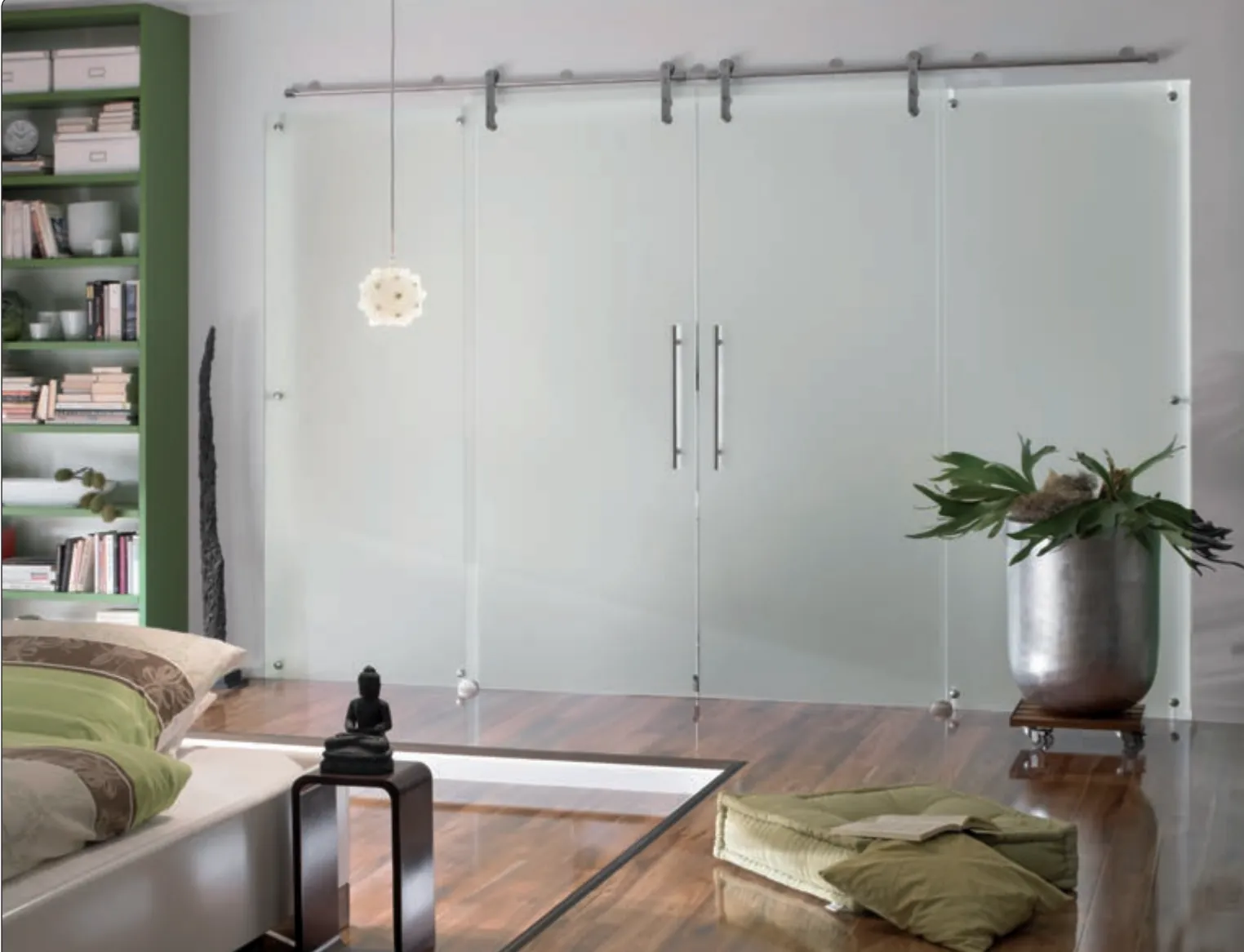
Installation glass is glass that is specially prepared for mounting with fittings. Think of glass with holes, recesses, notches or recesses for hinges, handles, clamps, locks or profiles. This concerns custom tempered glass where all operations are made in advance, so that the glass is immediately suitable for installation with the correct fittings. You encounter it with glass doors, shower walls, partition walls and other solutions where the glass is not simply placed straight into a frame.
The term installation glass is not an official type of glass such as HR++ glass or laminated glass. It mainly says something about the processes and the application: glass that has been made technically suitable for installation. In this article you can read exactly what installation glass is, what you use it for, why operations must always be carried out before hardening, which glass thickness and edge finish suit your application, and what you should pay attention to when ordering. Do you want to get started right away? Create your plate at custom installation glass.
What is installation glass?
Installation glass is custom produced for a specific installation. The glass is given the correct size, edge finish and operations required to install it in advance. With installation glass you can think of:
- Drill holes
- Hinge recesses
- Lock recesses
- Cutouts for handles
- Spaces for fittings
- Rounded corners
- Sharpened edges
- Notches
- Special shapes
- Recesses for profiles or clamps
The glass is therefore not only made to width and height, but also prepared for the way in which it will be mounted. That is why installation glass is especially important for glass that is part of a system, such as a door, shower wall or glass wall.
Is installation glass the same as tempered glass?
Not quite. Installation glass is usually tempered glass, but the term mainly says something about the processes and application. Tempered glass says something about safety and strength: it is made stronger by heat treatment and breaks down into small, harmless grains when broken. Installation glass is often tempered glass that has been additionally processed before installation.
| Term | Meaning |
|---|---|
| Tempered glass | Safety glass that is stronger and breaks safely |
| Installation glass | Glass prepared for mounting with fittings |
| Laminated glass | Glass with foil that stays together if broken |
| Insulating glass | Glass that retains heat better |
A glass shower door with holes for hinges is therefore often both tempered glass and installation glass. You can read more about the difference in Tempered glass: what is it? and Tempered or laminated glass?.
Why does installation glass usually have to be toughened?
Glass with holes, recesses or hinges is often used intensively. Think of a door that opens and closes, a shower wall that is cleaned daily or a glass plate that is secured with fittings. Tempered glass is usually the right choice, because it:
- Stronger than normal glass
- Safer breaks
- Can withstand bumps better
- Can withstand temperature differences better
- Suitable for doors and shower walls
- Often mandatory or sensible for intensive use
Installation glass is therefore not only about size, but also about safety. See also safety glass.
Why can't edits be done afterwards?
This is the most important point in installation glass: all holes and recesses must be made before tempering. Tempered glass is under tension after production. That tension makes the glass stronger, but also ensures that you can no longer cut, drill or grind it. If you try to do that, the entire window may explode into small grains.
Key point: with toughened installation glass, all holes and recesses must be correct before toughening. After hardening, you can no longer cut, drill or grind the glass - adjustments are not possible afterwards.
That is why these things must be exactly correct in advance:
- Width
- Height
- Glass thickness
- Edge finishing
- Position of boreholes
- Diameter of bore holes
- Cutouts for hinges
- Cutouts for locks
- Cutouts for handles
- Rounded corners
- Shape of the glass
A measurement error with installation glass is therefore annoying: you can usually no longer adjust the glass and it has to be produced again. Are you unsure about the dimensions? Then read Measuring glass.
What do you use installation glass for?
Installation glass is used in applications where glass is mounted with fittings or profiles.
| Application | Examples of operations |
|---|---|
| Glass door | Hinge holes, lock hole, handle holes |
| Shower enclosure | Holes for stabilizer bar, hinges or clamps |
| Shower door | Hinge recesses, handle holes |
| Glass partition wall | Cutouts for profiles or fittings |
| Counter glass | Drill holes or passage openings |
| Glass cabinet door | Hinge holes, handle holes |
| Interior glass | Notches or special shapes |
| Catering or retail glass | Openings for mounting or transit |
Installation glass is therefore especially useful when standard glass is not enough.
Installation glass for glass doors
Installation glass is almost always necessary for glass doors. A glass door needs fittings such as hinges, handles and sometimes a lock. Consider:
- Glass interior doors
- Pivot doors
- Sliding doors
- Shower doors
- Cupboard doors
- Office walls with door
- Glass doors in shops or showrooms
The holes and recesses must be in exactly the right place. The door should hang properly, turn smoothly and close securely. Please note:
- Direction of rotation
- Position of hinges
- Height of the handle
- Final position
- Space around the door
- Floor and ceiling height
- Fitting type
- Glass thickness
For glass doors, 8, 10 or 12 mm tempered glass is often used, depending on size and fittings.
Installation glass for shower walls
Shower walls and shower doors are typical examples of installation glass. The glass must not only be safe, but also fit exactly with the chosen fitting. Shower glass often requires operations for:
- Hinges
- Stabilizing bars
- Wall profiles
- Handles
- Doorknobs
- Glass clamps
- Magnetic strips
- Sealing profiles
Shower glass is usually made of tempered glass. This is important because the glass has to deal with temperature differences, water, cleaning products and daily use. The edge finish also counts: with shower glass, the edges are usually ground flat poly, which gives a smooth, safe and neat edge. See also Custom-made shower enclosure: what to look out for?.
Installation glass for hinges
Hinges require very precise machining. Depending on the type of hinge, drilled holes, slots or special recesses are required. NB:
- Hinge type
- Glass thickness
- Center-to-center size of holes
- Distance to the glass edge
- Direction of rotation
- Weight of the glass plate
- Attachment to wall, frame or glass
- Required clearance around the door
Always use the technical drawing of the fitting. This shows the exact dimensions for holes and recesses. Don't guess based on photos — a few millimeters of deviation can cause the hinge to not fit.
Installation glass for handles and knobs
Handles, door knobs and pull handles also often require drilling holes in the glass. Important choices are:
- Single button or double button
- Vertical or horizontal grip
- Diameter of the borehole
- Height of the handle
- Distance to the edge
- Placed left or right
- Inside or outside
Many glass handles have a bolt that goes through the glass. The hole must therefore fit exactly with the chosen fitting. Always use plastic or rubber rings between metal and glass: metal should not clamp directly hard against glass.
Installation glass with cutouts
Sometimes regular round holes are not enough and cutouts are needed. Examples:
- Corner recess
- Notch for a hinge
- Recess for a lock case
- Space for a profile
- Recess at a skirting board
- Recess around a pipe
- Sloping side
- Rounded corner
- Special shape
These operations must also be made before hardening. Therefore, always make a clear drawing with all dimensions in millimeters.
Which edge finish do you choose?
With installation glass, the edges are often visible and touchable. A neat edge finish is therefore important.
| Edge finishing | When to use? |
|---|---|
| Rounded sharp edges | If the edge is less visible |
| Flat ground | Neat functional edge |
| Flat poly cut | Beautiful visible and smooth edge |
| Facet cut | Decorative glass |
| Rounded corners | Extra safe at doors and walls |
For doors, shower walls and interior glass, flat poly cut is often the best choice. More about this in Edge finishing: sharp edges or ground?.
What thickness of glass do you need?
The correct glass thickness depends on the application, size and fitting.
| Application | Commonly used thickness |
|---|---|
| Small closet door | 6 mm |
| Shower enclosure | 8 or 10 mm |
| Shower door | 8 or 10 mm |
| Glass interior door | 8 or 10 mm |
| Large glass door | 10 or 12 mm |
| Partition wall | 10 or 12 mm |
| Counter glass | 8 to 12 mm |
These are general guidelines. The chosen fitting often determines what glass thickness is possible, so always check whether the fitting is suitable for the chosen thickness. Are you still in doubt? Read What glass thickness do I need?.
Installation glass or standard glass?
Standard glass is sufficient when the glass is only placed in a frame or profile without special processing. Installation glass is necessary when the glass needs to be adjusted for installation.
| Situation | Glass selection |
|---|---|
| Window in standard frame | Ordinary glass or insulating glass |
| Shower enclosure with holes | Installation glass |
| Glass door with hinges | Installation glass |
| Table top without holes | Tempered glass, usually not installation glass |
| Glass plate with recess | Installation glass |
| Balustrade with point holders | Installation glass or balustrade glass with drilled holes |
| Mirror with bonding only | Custom mirror, usually no installation glass |
The difference is mainly in the operations.
Installation glass and safety
Because installation glass is often used in doors, shower enclosures and walls, safety is important. NB:
- Do not use normal float glass for doors or shower walls
- Choose tempered glass for intensive use
- Choose laminated glass if there is a risk of falling through
- Choose tempered-laminated glass for heavy safety applications
- Avoid direct contact between metal and glass
- Use suitable batter
- Check that the glass is not mounted under tension
Tempered glass usually makes sense for a glass door. Laminated or tempered laminated glass is often necessary for a balustrade or situation with a height difference.
Common mistakes with installation glass
- Thinking that holes can still be made later — With tempered installation glass, holes cannot be made afterwards.
- Do not use technical drawing — Fittings have exact dimensions; always use the working drawing of the hinge, handle or profile.
- Choose the wrong glass thickness — Not every hinge fits every glass thickness; check this in advance.
- Not enough clearance around doors — A glass door needs space to rotate freely and not rub against the floor, wall or profile.
- Clamp metal directly against glass — Always use suitable rubbers, rings or plastic protection.
- Do not take the direction of rotation into account — For doors and hinges, left or right is important.
- Choosing the wrong edge finish — With visible glass, ground and polished edges are usually nicer and safer.
- Confusing installation glass with insulating glass — Installation glass is about installation and operations; Insulating glass is about heat insulation.
Order checklist for installation glass
- What is the glass used for?
- Should the glass be tempered, laminated or tempered-laminated?
- Which glass thickness suits the fitting?
- Do you have the exact width and height?
- Are all sizes in millimeters?
- Are drill holes necessary?
- Are recesses needed?
- Do you have the technical drawing of the fitting?
- Are the center-to-center dimensions correct?
- Is the distance to the glass edge correct?
- Is the direction of rotation clear?
- Has the edge finish been chosen?
- Are corners rounded where necessary?
- Is there sufficient clearance around the door or wall?
- Is the glass suitable for indoors, outdoors or bathroom?
Conclusion
Installation glass is glass that is specially prepared for installation. It is usually custom tempered glass with operations such as holes, recesses, hinge notches or recesses for fittings. This makes it suitable for glass doors, shower walls, partition walls, cupboard doors and counter glass.
The main thing to remember: all operations must be made before hardening. After hardening, you can no longer cut, drill or grind the glass. Use installation glass when the glass becomes part of a mounting system and always check the glass thickness, edge finish, dimensions and technical drawing of the fitting. This prevents holes from being placed incorrectly, hinges from not fitting or the glass having to be re-produced.
Ready to order? Create your plate directly at custom installation glass, view the category installation glass or go to the general overview custom glass. Are you unsure whether you need safety glass? Delve further into tempered glass, tempered or laminated glass and custom shower enclosure.